There is a version of the AI outreach conversation that goes like this: AI is going to replace your BDC. Human touch does not matter anymore. Dealers who trust technology over people will win.
That framing is wrong, and it is worth being direct about why.
The BDC does things that AI cannot. A skilled rep who has been working a store’s book of business for two years brings relationship knowledge, situational judgment, and the ability to read a conversation in real time that no outreach system replicates. When a high-value customer calls in with a complex trade situation, or a longtime buyer needs someone who remembers their history with the store, a good BDC rep is not replaceable.
The debate is not about trust in technology versus trust in people. The debate is about scale: what can a BDC team do at volume and what can it not do, regardless of how skilled the team is.
That is a different question, and it has a different answer.
What a Human BDC Does Better
The BDC functions where a human is genuinely the right tool:
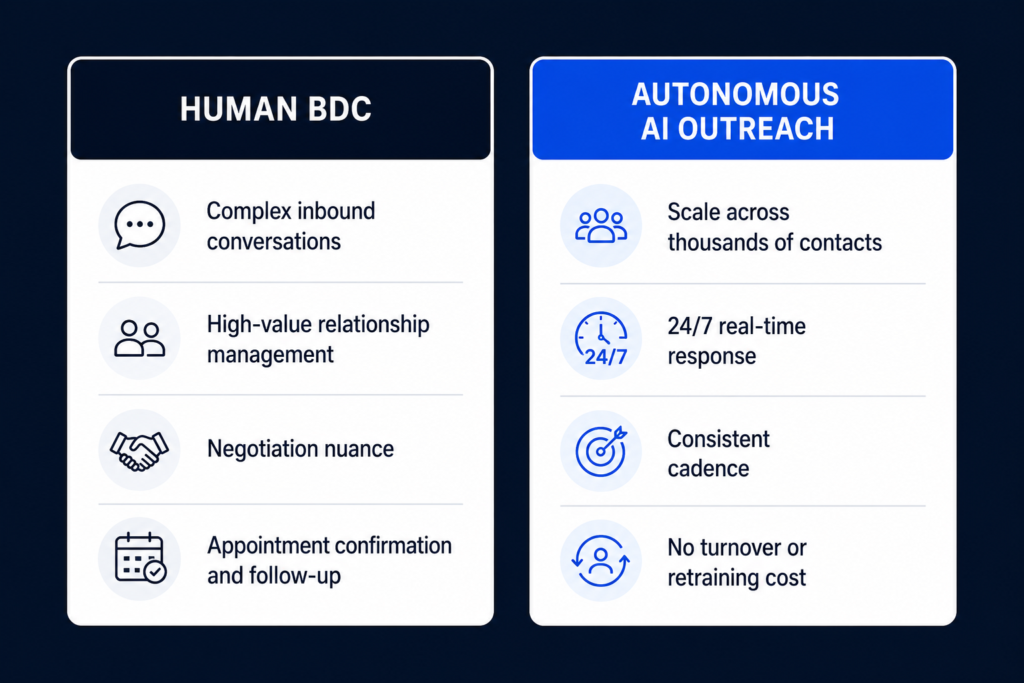
High-stakes inbound conversations. A prospect who has done their research, is comparing multiple stores, and calls in with specific questions about pricing, availability, or trade value is a conversation that benefits from human judgment. The rep can read the tone, adjust the approach, and use real-time flexibility that a scripted outreach system cannot match.
Complex or sensitive customer situations. A customer with a difficult trade situation, negative equity, or a history of service complaints requires someone who can navigate nuance. Automated outreach cannot handle the emotional dimension of a conversation that has context.
Relationship management with high-value accounts. Dealer principals, fleet customers, repeat buyers with significant transaction history: these relationships benefit from human continuity. The customer expects to talk to a person, and the value of the relationship justifies the capacity investment.
Confirmation, follow-up, and no-show recovery. Once an appointment is set, the human follow-up cadence matters. Confirmation calls, day-before reminders, and outreach to no-shows are high-touch moments where a real voice outperforms a text sequence.
These are real strengths. A BDC team that does all of them well is a genuine asset to the store’s revenue performance. None of them are going away.
What AI Outreach Does Better
The strengths of autonomous outreach are in a different part of the workflow entirely:
Volume without a capacity ceiling. An AI outreach system can simultaneously maintain an active conversation cadence with thousands of past buyers in the upgrade window. A BDC team of three or four reps, running a full inbound queue, cannot. The math does not work regardless of how productive the reps are. As covered in the BDC capacity breakdown, a dealer with 8,000 past buyers has 1,200 to 2,400 upgrade-eligible contacts at any given time. Working that population through a multi-touch outreach sequence requires a different capacity model entirely.
Consistency without deprioritization. A human team deprioritizes outreach when inbound volume picks up. An AI outreach system does not. The cadence runs the same on a busy Monday as it does on a slow Wednesday. That consistency is what produces reliable monthly appointment volume rather than sporadic campaign results.
24/7 availability. Past buyers respond to outreach when they have time, not during business hours. A text that arrives at 8pm on a Tuesday gets a response at 8pm on a Tuesday. An AI system handles that response in real time. A BDC team picks it up the next morning, after the customer has moved on or responded to something else.
No turnover, no retraining. BDC turnover in automotive runs 50 to 80 percent annually. Every departure costs the store in recruiting, onboarding, and lost productivity. An AI outreach system does not resign, does not need retraining, and does not take two months to reach full productivity after a team change.
The Complementary Model
When you put those two sets of strengths together, the operational model becomes clear.
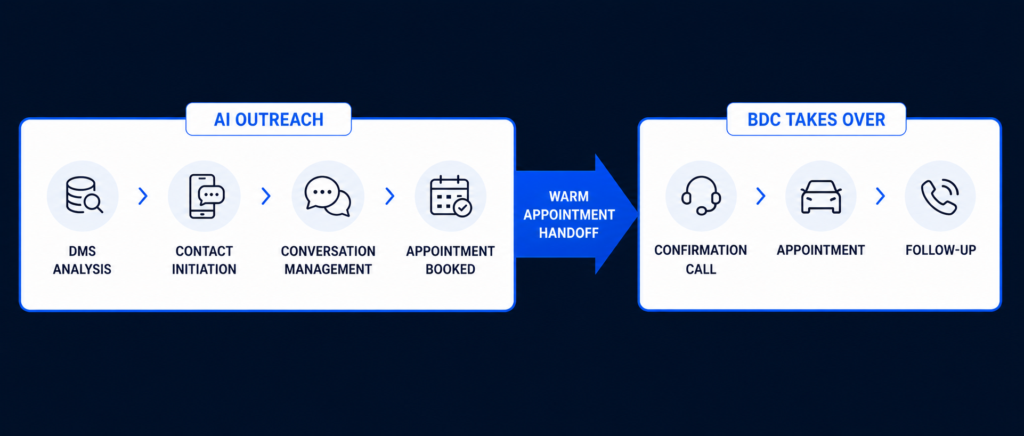
The AI outreach system works the past buyer population in the DMS: identifying upgrade-eligible contacts, initiating personalized conversations via SMS and email, handling the initial outreach cadence, managing objections and appraisal requests, and booking the appointment. That is the part of the workflow that requires volume, consistency, and 24/7 availability.
The BDC receives the warm appointment: a past buyer who has already been through the qualifying conversation, has confirmed their interest in trading, and is scheduled to come in. From that point, the human takes over. Confirmation call, pre-appointment prep, the appointment itself, and any follow-up if the customer does not show.
Neither function replaces the other. They operate in sequence. The AI creates the appointment opportunity at scale. The human converts it.
The result is a used vehicle acquisition channel that produces consistent monthly volume without requiring the BDC to carry both the inbound queue and the outreach motion simultaneously. The two jobs run in parallel, each handled by the tool built for it.
What This Model Produces
The question dealers ask at this point is reasonable: does this actually work at scale, or does it sound better in theory than it performs in practice?
Koons Motors generates 53 trade-in appointments per month from past buyers using this model. The AI outreach system works the past buyer population in their DMS. The BDC handles the appointments the system books. The two functions run in parallel without the BDC carrying the full outreach load.
The $190,000 in monthly gross Koons produces from this channel does not come from replacing their BDC. It comes from giving their BDC better inventory to work with: warm appointments from people who already have a relationship with the store, who have already expressed interest in trading, and who arrived at the conversation before a competitor reached them first.
That is the complementary model in practice. Not AI instead of people. AI doing the scale work that people cannot do, so that people can do the relationship work that AI cannot.
Find out what your past buyers could produce →
FAQs
No. Autonomous AI outreach handles the proactive past buyer outreach motion: identifying upgrade-eligible contacts, initiating outreach, managing the conversation, and booking the appointment. The BDC handles what follows: confirmation, the appointment itself, negotiation, and follow-up. The two functions are sequential, not competitive. Dealers running this model do not reduce BDC headcount. They give the BDC higher-quality appointments to work.
Human BDC reps excel at complex inbound conversations that require situational judgment, high-value customer relationship management, real-time negotiation, and the emotional nuance of conversations where history, trust, or sensitivity matter. These are contexts where human judgment produces better outcomes than any automated system. They are also the contexts where a good BDC team’s time is best invested.
Autonomous AI outreach handles volume, consistency, and availability at a scale a human team cannot match. Maintaining a multi-touch outreach cadence across thousands of past buyers simultaneously, responding to contacts at any hour, and sustaining that cadence without deprioritization when inbound volume picks up are structural advantages that do not depend on rep skill or staffing levels.
The AI outreach system manages the past buyer conversation through to appointment confirmation. Once the appointment is booked, the BDC receives a warm lead with context on the vehicle and the customer’s stated interest. The rep handles confirmation, pre-appointment preparation, the appointment itself, and any follow-up. The handoff happens at the point where human judgment and relationship skills add the most value.
The complementary model works across dealer sizes, though the scale of outreach volume and appointment production scales with DMS size and transaction history. Single-rooftop dealers using this model typically generate 6 to 27 trade-in appointments per month from past buyers. The model does not require a large BDC team to function: a BDC of two to three reps handling inbound alongside an AI outreach system running past buyer contact is a workable operational structure for most mid-size franchise dealers.
Related reading:
- Your BDC Has a Capacity Problem. Your Past Buyers Are Paying for It.
- Most Dealers Have No Idea What a BDC Appointment Actually Costs Them
- Your BDC Was Built for Inbound. That’s the Problem.
- Your Past Buyers Are Shopping Right Now. Are You Reaching Them First?
- How Koons Motors Gets 53 Trade-Ins a Month From Customers They Already Have
- Where Dealer Gross Actually Comes From in 2026