
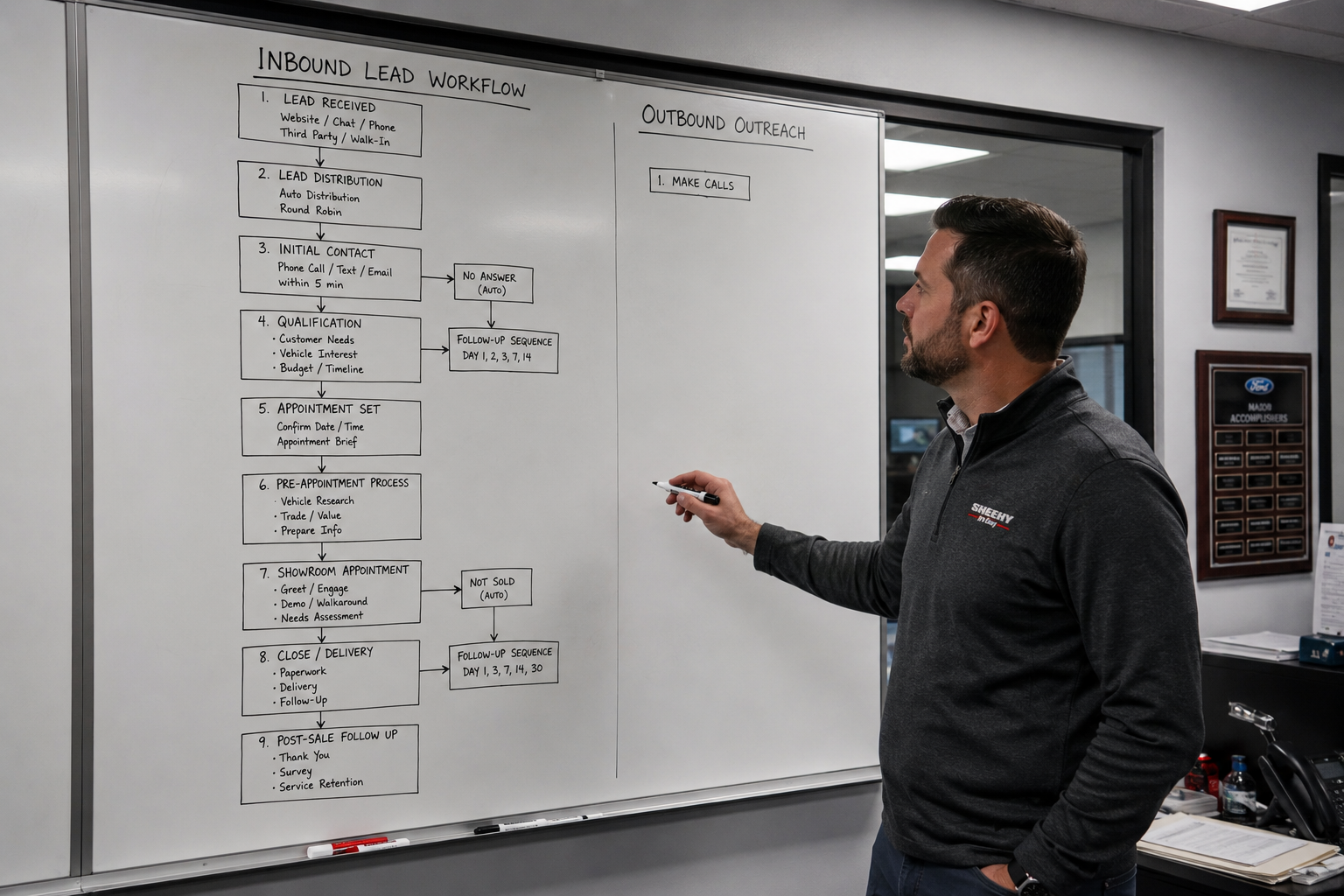
If you built a BDC from scratch today, you would think carefully about what job you were hiring it to do.
You would hire for responsiveness. You would train on lead conversion scripts. You would measure response time, contact rate, appointment set rate, and show rate. You would build the incentive structure around closing the gap between an inbound inquiry and a booked appointment.
That is a well-designed BDC for inbound lead response.
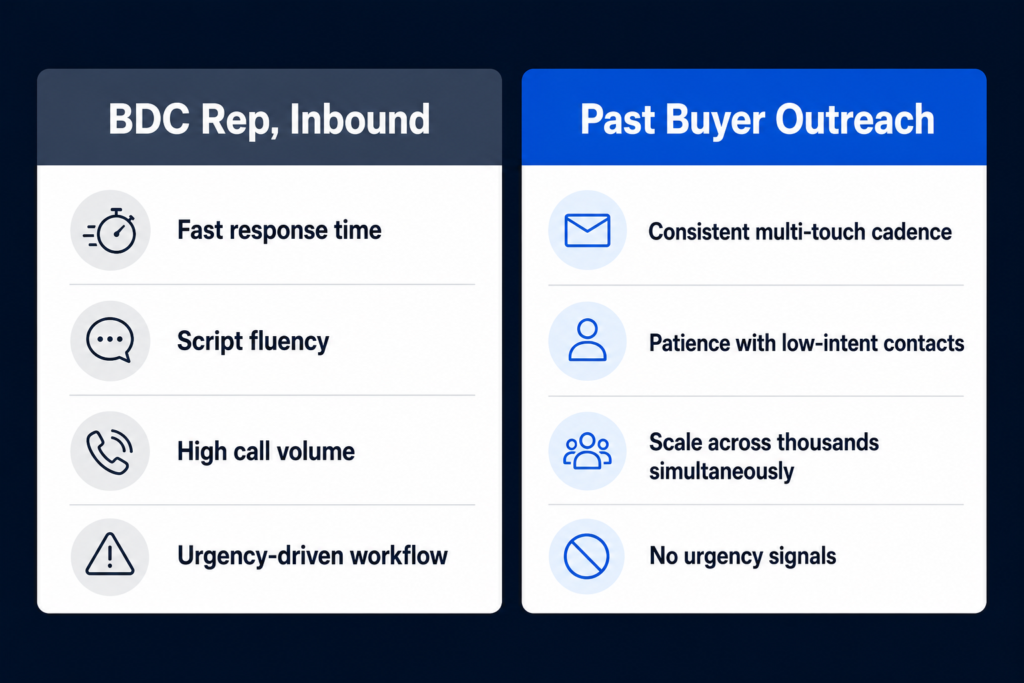
It is not a well-designed system for proactively reaching thousands of past buyers who have not raised their hand, who are not in an active shopping mindset, and who need a different kind of conversation entirely before they will consider trading their current vehicle.
Most dealers are asking the same team to do both jobs. That is where the structural problem starts.
What the BDC Was Actually Designed For
The modern dealership BDC exists because dealers needed a dedicated team to handle the volume and speed requirements of internet lead response. When digital leads became the primary top-of-funnel source in the early 2000s, stores found that their sales floor could not manage the response time and follow-up cadence those leads required. The BDC was the answer.
Everything about how BDCs are built reflects that origin. The hiring criteria favor people who are comfortable on the phone and can handle fast-paced, repetitive outreach. The training focuses on lead objections, appointment scripts, and confirmation calls. The metrics track inbound lead performance. The incentive structure rewards appointment sets from leads that came in the door.
None of that is wrong. For the job the BDC was built to do, it is the right design.
The problem is that proactive outreach to past buyers is a fundamentally different job, and it requires a different design.
What Past Buyer Outreach Actually Requires
When you reach out to a past buyer in your DMS, you are not responding to an expressed need. You are initiating a conversation with someone who has not thought about trading their current vehicle today, who may not think about it for another three months, and who has an existing relationship with your store that is either an asset or a liability depending on their last experience.
Getting that person to book a trade-in appointment requires something inbound training does not develop: the patience to work a long, low-urgency outreach cadence across thousands of contacts simultaneously, without the urgency signals that keep an inbound team focused.
Inbound has natural urgency. A lead came in. There is a timestamp. The manager is watching response time. The rep picks up because not picking up has visible consequences.
Outbound to past buyers has none of that. There is no lead to respond to. There is no timestamp telling the rep they are already two minutes past the response window. The manager’s attention is on the inbound queue. And so the past buyer outreach cadence gets worked when there is time, which means it gets worked inconsistently, which means it does not produce reliable volume.
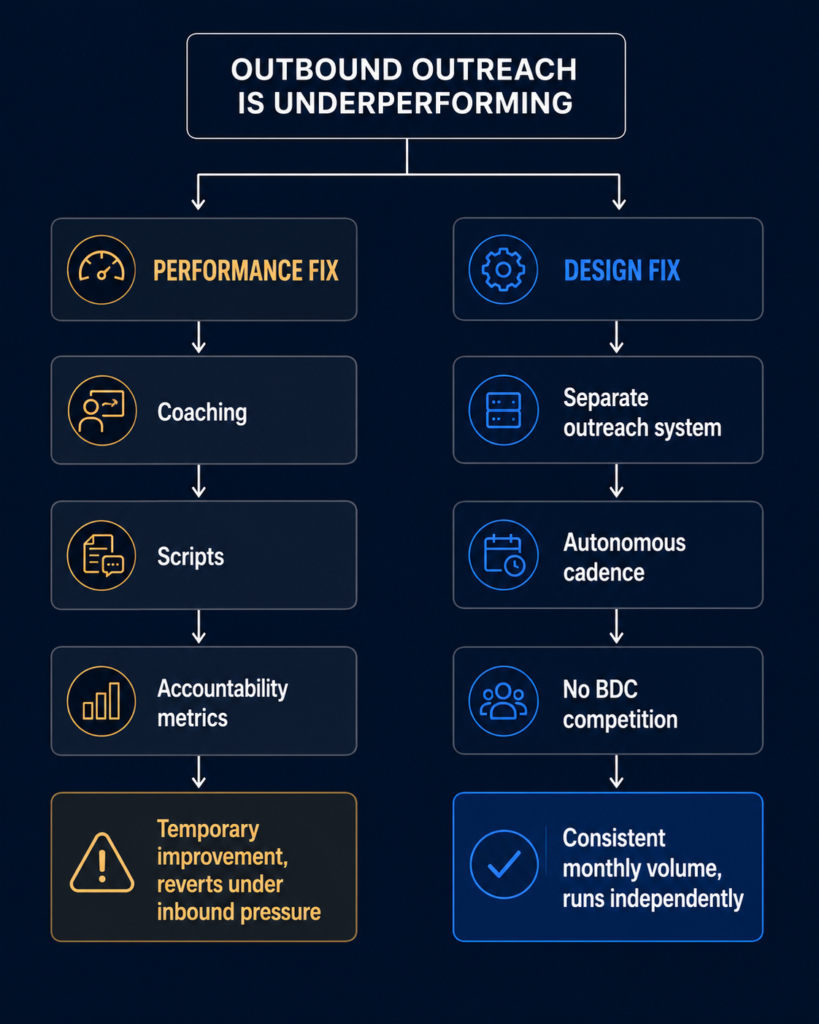
This is not a motivation problem or a skills problem. It is a design problem. You cannot solve it by coaching the BDC to be more proactive. You solve it by recognizing that the two jobs have different structural requirements and designing accordingly.
The Incentive Structure Problem
There is a second layer to the mismatch that makes it worse: most BDC incentive structures do not reward past buyer outreach at the same rate as inbound lead conversion, even when the appointment produces significantly better results.
An inbound lead that converts to a shown appointment gets credited to the rep. The set rate and show rate are tracked. The manager sees the output. The rep gets the recognition and any tied compensation.
A past buyer outreach appointment that converts to a trade-in and a new vehicle sale generates far more gross than an inbound internet lead appointment. But if the rep is spending time working a low-urgency outreach cadence instead of picking up inbound leads, their visible metrics look worse, not better. The inbound queue shows as slower. The manager notices.
So the rep makes the rational choice: work what gets measured. Past buyer outreach falls to the bottom of the priority stack, and stays there.
Fixing this requires either redesigning the incentive structure around outreach output, or separating the jobs so the two motions are not competing for the same attention and the same recognition.
Why This Is a Design Problem, Not a Performance Problem
The distinction matters because it changes what you do about it.
If you believe your BDC is underperforming on past buyer outreach because of motivation or skill, you invest in coaching, scripts, and accountability metrics. You hold the team to a higher standard on outreach volume. You track dials and contacts per day.
Those interventions will produce a temporary improvement. They will not produce a sustainable system. The structural forces that deprioritize past buyer outreach, urgency signals favoring inbound, incentives rewarding inbound metrics, manager attention focused on inbound performance, will reassert themselves the moment call volume picks up.
If you recognize it as a design problem, you look for a different solution: a system built specifically for the proactive, high-volume, low-urgency outreach motion that past buyer activation requires. One that runs consistently regardless of inbound volume, does not compete for BDC capacity, and does not depend on human attention to maintain cadence across thousands of contacts.
That is what separates the dealers generating 20 to 30 trade-in appointments per month from past buyers from the dealers who ran a one-time campaign, saw inconsistent results, and concluded that their database does not convert. Koons Motors does not get 53 appointments a month from past buyers by coaching their BDC to be more proactive. They run a system designed for that specific job.
What This Means for Your BDC
None of this is an argument that your BDC is failing. A well-run BDC doing what it was designed to do is a genuine asset. The argument is that asking it to also run systematic outbound outreach to thousands of past buyers at scale is asking it to do something it was not designed to do.
The capacity math makes this explicit. The cost per appointment makes the economics clear. And the results from dealers who have separated the two jobs make the outcome visible.
Your BDC was built for inbound. Let it be excellent at that. The past buyer outreach motion needs its own system.
Find out what your past buyers could produce →
FAQs
BDC teams are designed, trained, and incentivized around inbound lead response. That job rewards speed, urgency, and high call volume. Proactive past buyer outreach requires patience, a consistent multi-touch cadence across thousands of contacts, and the ability to sustain that cadence without urgency signals. When both jobs are assigned to the same team, inbound always takes priority because it is measured, visible, and tied to compensation.
It is structural. Training and coaching can produce short-term improvements in outreach volume, but the underlying design forces that deprioritize past buyer outreach will reassert themselves when inbound volume picks up. Sustainable improvement requires separating the two jobs so they are not competing for the same attention, incentives, and management focus.
Inbound BDC response is reactive: a lead arrives, the rep responds, the appointment is set or not. Past buyer outreach is proactive: the dealer identifies upgrade-eligible contacts, initiates the conversation, manages a multi-touch cadence over time, and moves low-intent contacts toward an appointment that may be weeks away. The skills, pace, and design requirements are different enough that combining them in one team without structural separation reliably produces underperformance on the outreach side.
Dealers generating consistent monthly past buyer appointment volume run an autonomous outreach system alongside their BDC rather than through it. The AI handles identification, contact initiation, conversation management, and appointment booking for past buyers. The BDC handles inbound. The two motions run in parallel without competing for capacity, which is why dealers like Koons Motors can generate 53 trade-in appointments per month without expanding their BDC team.
Redesigning incentives to recognize past buyer outreach output is a valid approach, but it does not solve the capacity and urgency-signal problems that cause deprioritization. Even with strong incentives for outreach, a rep managing an inbound queue cannot simultaneously maintain a consistent multi-touch cadence across thousands of past buyer contacts. The jobs require different capacity models, not just different incentive structures.
Related reading:
- Your BDC Has a Capacity Problem. Your Past Buyers Are Paying for It.
- Most Dealers Have No Idea What a BDC Appointment Actually Costs Them
- Your Own Customers Are Your Highest-Margin Inventory Source. Here’s the Math.
- How Koons Motors Gets 53 Trade-Ins a Month From Customers They Already Have
- Where Dealer Gross Actually Comes From in 2026