



















Wholesale used-car values rose 0.5% in October and moved back above last year, one month after slipping below it for the first time in 2026. The rebound was narrow. Compact cars and EVs carried it, while pickups, SUVs and luxury kept sliding, and light-duty trucks finished 4.3% below last October. Retail listing prices began to ease, but used cars under $15,000 got even scarcer. New-car prices hit a record above $51,000, and new FCC texting rules take effect November 25. For dealers, November is the month to buy the right cars from the right owners, and to get opt-outs right before the holiday rush.
Wholesale: a rebound, but only for some cars
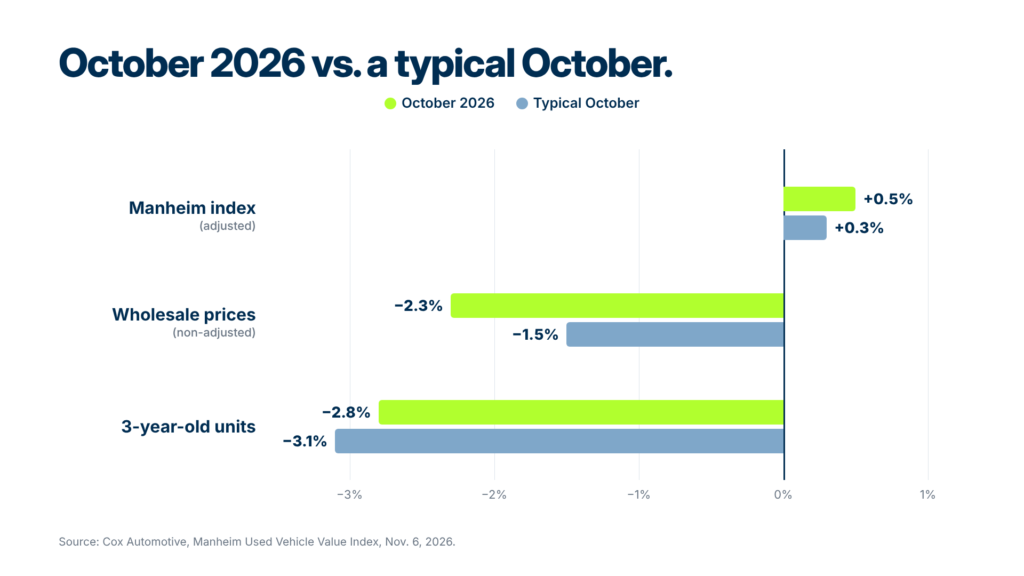
The Manheim index rose 0.5% from September to 206.8 in October and finished 2% above October 2025 (Cox Automotive, Nov. 6). A typical October gains 0.3% on an adjusted basis, so values did slightly better than usual.
The raw prices tell a softer story. Non-adjusted values fell 2.3% from September, more than the usual 1.5% October dip. Cox's Jeremy Robb put it plainly: "October is generally the weakest month of the year." Three-year-old units lost 2.8%, a little better than the typical 3.1%.
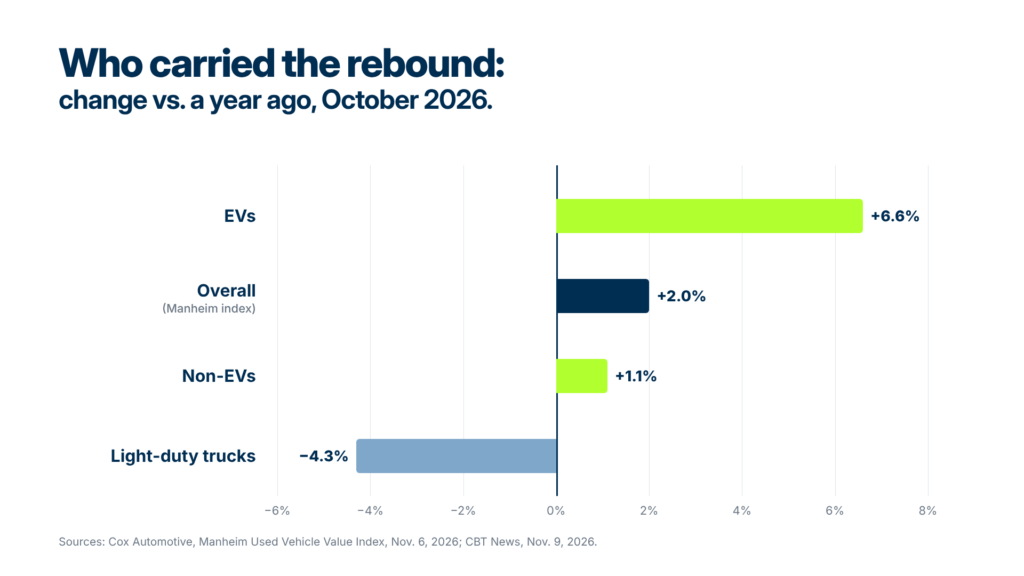
The gains were not shared. EVs finished 6.6% above last year and non-EVs only 1.1%. Compacts held their strength, while luxury, pickups and SUVs kept trending down. Light-duty trucks ended 4.3% below last year, against a 0.3% gain for the market as a whole (CBT News, Nov. 9).
Auction supply is steady. Wholesale days' supply ended October at 28.1, about even with last year, and sales conversion was 54.2%, right at the three-year October average.
What it means for your store: the rebound is real for small, efficient cars and missing for trucks. A unit bought at auction this month still loses value faster than usual while it waits, so what you pay and how fast it turns matter more than the headline index.
Retail: prices easing, affordable cars even scarcer
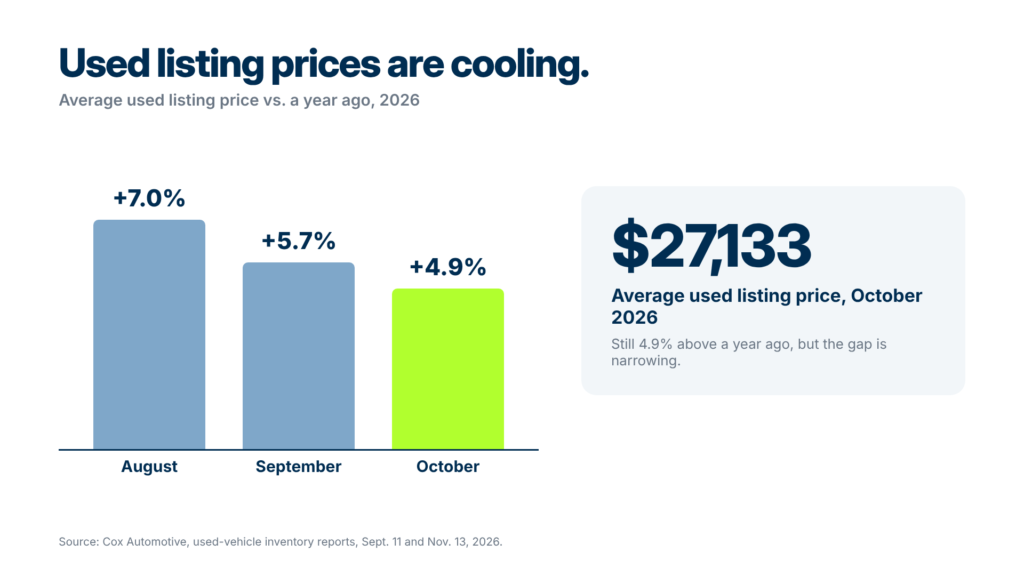
Used inventory slipped 0.9% from September to 2.19 million units in October, about even with a year ago, at 49.2 days' supply (Cox Automotive, Nov. 13). The average listing price eased to $27,133. That is still 4.9% above last year, but the gap has narrowed from 7% in August and 5.7% in September.
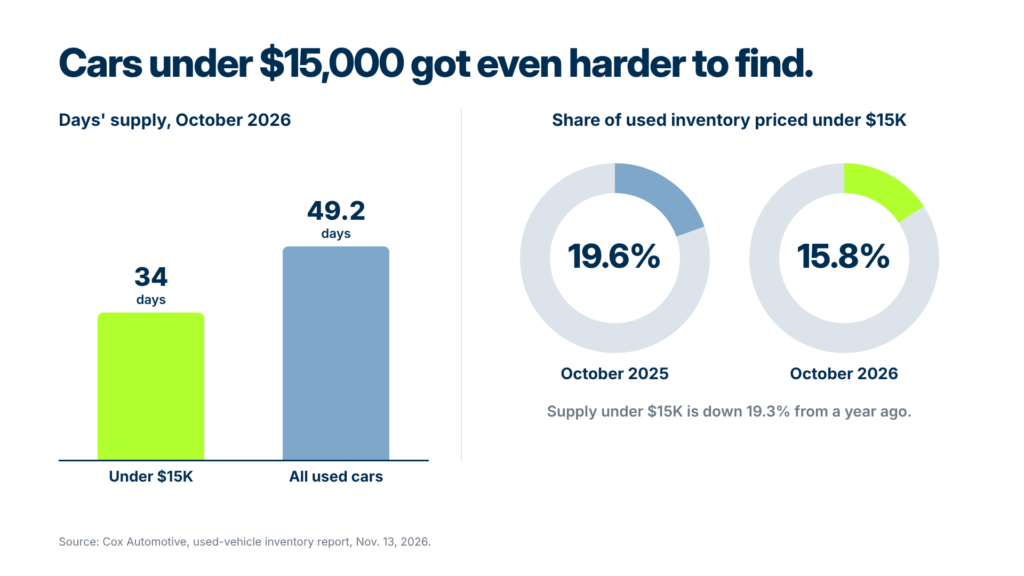
The squeeze at the bottom of the market got worse. Supply of used cars under $15,000 fell 19.3% from a year ago. That band is now 15.8% of used inventory, down from 19.6%, with just 34 days' supply, 15 days below the industry average.
Shoppers slowed down. The retail used sales pace fell 1.3% from last year and 2.5% from September, with about 1.38 million units sold. Certified pre-owned was the exception: CPO sales rose 9% from a year ago to an estimated 226,000, and CPO's share of used retail climbed to 16.4%.
What it means for your store: retail prices are starting to come down, so overpaying for a unit now costs you faster. The affordable cars shoppers ask for are the hardest to buy at auction, and many of them are sitting in your past buyers’ driveways. Late-model trades from your own customers are also the cleanest path to CPO units, the one part of used retail that grew in October.
Trade-in equity: fewer underwater, but deeper
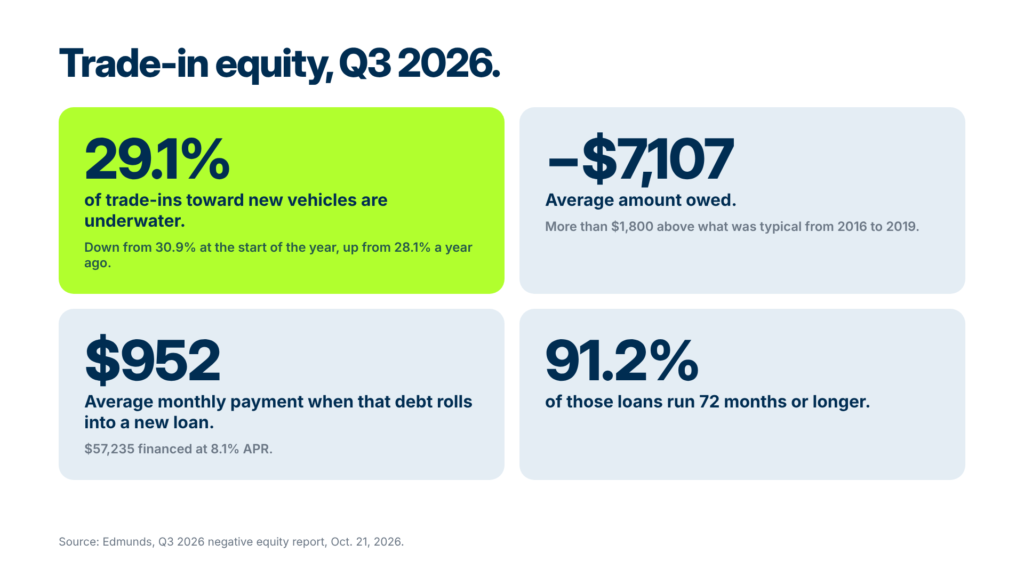
In Q3, 29.1% of trade-ins toward new vehicles carried negative equity, down from 30.9% at the start of the year but up from 28.1% a year ago (Edmunds, Oct. 21). The average underwater owner owed $7,107, more than $1,800 above what was typical from 2016 to 2019.
Rolling that debt forward is getting expensive. Buyers who carried negative equity into a new loan financed an average of $57,235 at 8.1% APR, for a $952 monthly payment. 91.2% of those loans ran 72 months or longer.
The other side is still strong. Average positive equity hit a record $13,330 in Q2 (Edmunds). Edmunds’ Q3 positive-equity figures had not been published at press time.
What it means for your store: your past buyers are not one group. Owners with equity can trade today without stretching their payment. Owners who are underwater need a different conversation, and a $952 payment is a hard sell in a soft-traffic quarter. Know which is which before anyone reaches out.
New sales: the pace slowed and prices hit a record
October's new-vehicle sales pace came in at 15.5 million, below Cox's 16.1 million forecast and 0.9% under last October (Cox Automotive, Nov. 9). Volume reached 1.32 million units, up 2.9%, but fleet did much of the work. Retail sales rose just 0.6%, and the retail pace fell to 12.6 million from 13.1 million.
Prices kept climbing. The average new-vehicle transaction price topped $51,000 for the first time, up 2.1% from a year ago. With inflation near 4% and the Fed likely to keep raising rates, financing is not getting cheaper soon. Gas has started to ease but still averages $4.07 a gallon.
What it means for your store: new-car shoppers are stretched, so more of them will look at used, and more owners will keep the car they have a little longer. Both trends put more value in the customers already in your DMS.
Compliance watch: new opt-out rules start November 25
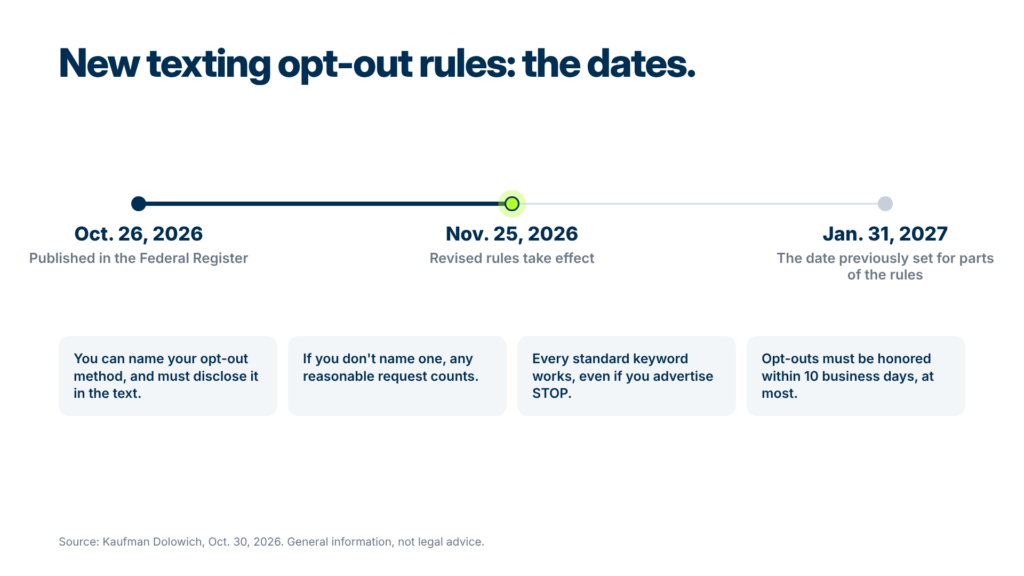
The clock we flagged last month has started. The FCC's revised TCPA consent-revocation rules were published in the Federal Register on October 26 and take effect November 25, 2026 (Kaufman Dolowich, Oct. 30). That replaces the January 31, 2027 date previously set for parts of the rules.
- You can name your opt-out method. A business can designate exclusive ways to opt out, such as a reply keyword, but must disclose that method clearly in the text itself.
- If you don’t name one, any reasonable request counts. A customer who says “don’t text me again” in their own words has still opted out.
- Every standard keyword works. Even if you advertise STOP, you must honor any of the FCC-recognized keywords.
- Ten business days, at most. Opt-outs must be honored within a reasonable time, no more than 10 business days.
- Marketing texts did not loosen. A STOP on an informational text can apply only to that category. A STOP on a sales or marketing text still ends all marketing texts from that sender.
The courts are not waiting either. On October 28, a federal court in Texas refused to dismiss a TCPA suit against a dealership, Red McCombs, and held that text messages count as calls under the Do Not Call rules (National Law Review). Courts around the country are split on that question, so where a dealer is sued can decide whether a texting case survives.
What it means for your store: check every tool that texts your customers, including your CRM, your BDC platform, your service reminders and any AI agent. They should all disclose the same opt-out method and honor it on the first request. This is general information, not legal advice; review your program with counsel.
November's playbook: buy into the rebound, not the slide
October's data points to four moves for the next 30 days.
- Source the segments that bounced back. Compacts and EVs carried October’s gain, and EVs finished 6.6% above last year. Look first at past buyers driving compact cars and EVs, which are worth more at trade today than they were a month ago.
- Keep appraising trucks and SUVs against this week’s values. Light-duty trucks finished 4.3% below last year while the market rose. Price them on current numbers, not on last quarter’s, and move aging units before winter.
- Start with owners who have equity. With 29.1% of trade-ins underwater by an average of $7,107, sort your past buyers by equity first, and reach the owners who can trade without stretching their payment.
- Lock down opt-outs before November 25. Pick your opt-out method, put it in every text, and test that each tool that texts your customers honors it on the first request.
That is what we build at inride. Trade Agent AI finds the past buyers in your DMS who are ready to trade and books the appointment for your team; up to 40% of past buyers respond. At Koons Motors, it produced $190,633 in combined profit across three rooftops in three months. Trade Agent Acquire works every trade-in lead on your website in seconds, 24/7.
Book a call to see what your past buyers could produce before year-end.
Sources
- Manheim Used Vehicle Value Index: October 2026 Trends, Cox Automotive, Nov. 6, 2026
- Wholesale used-vehicle prices rise 2% year over year in October, CBT News, Nov. 9, 2026
- Used-Vehicle Sales and Inventory Dip in October, but CPO Sales Climb 9%, Cox Automotive, Nov. 13, 2026
- Q3 2026 negative equity report, Edmunds, Oct. 21, 2026
- Record positive trade-in equity, Edmunds, Q2 2026 data
- Auto Market Weekly Summary, Cox Automotive, Nov. 9, 2026
- FCC Revises TCPA Consent-Revocation Rules: What Businesses Should Know Before November 25, Kaufman Dolowich, Oct. 30, 2026
- Text messages are still calls under the TCPA’s DNC rules (Feliciano v. Red McCombs), National Law Review, Oct. 2026