There is a version of the BDC that almost every franchise dealer runs. It fields internet leads. It handles phone ups. It follows up on unsold showroom traffic. It books appointments, confirms them, reschedules the no-shows, and logs everything in the CRM. When it is staffed well and managed tightly, it does that job reasonably well.
That is not the same job as reaching out to the several thousand past buyers sitting in your CRM right now.
Those are two different operational motions. And the fact that most dealers assign them to the same team, with the same staffing model and the same incentive structure, is the reason most dealers are not systematically generating trade-in appointments from the customers they already have.
This is not a performance problem. It is a capacity problem. And the distinction matters, because performance problems get solved by coaching and accountability. Capacity problems get solved by redesigning the system.
The Two Jobs Your BDC Is Being Asked to Do
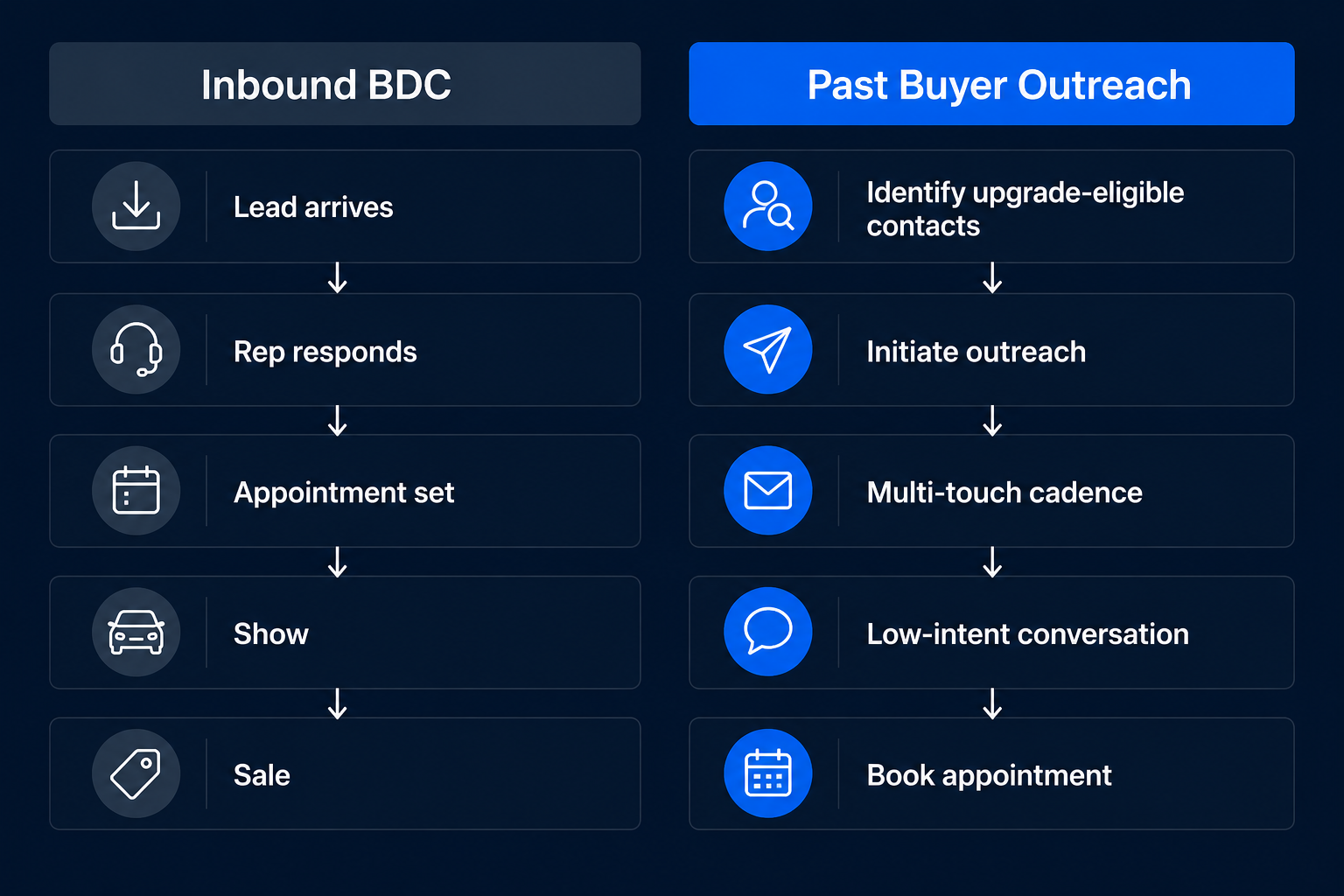
When a franchise dealer talks about BDC performance, they are almost always talking about inbound performance: response time on leads, contact rates, appointment set rates, show rates. Those metrics make sense for an inbound workflow because the inbound workflow has a defined input and a measurable output: a lead arrives, the BDC responds, and the result is tracked.
Outbound outreach to past buyers has a completely different shape. There is no lead to respond to. The BDC has to initiate the contact, identify the right customers to contact, sequence the outreach, handle a conversation that did not start with an expressed purchase intent, and do that across thousands of contacts on a consistent schedule. Not as a one-time campaign. As an ongoing operational motion.
Those two jobs require different skills, different pacing, and different incentive structures. Inbound is reactive and urgent. Outbound to past buyers is proactive and patient. A rep who is excellent at converting a hot internet lead is not automatically well-suited to working a database outreach cadence, and vice versa.
When you assign both jobs to the same team without distinguishing between them, the reactive job wins every time. Inbound leads have a timestamp on them. The manager watches response time. The rep feels the pressure to pick up. Past buyer outreach does not have that urgency signal. So it gets deprioritized the moment the phone is ringing.
The result is a CRM full of past buyers who are in their vehicle upgrade window right now and have not heard from you in 18 months.
The Capacity Math
Here is what the capacity problem looks like when you run the numbers on a typical single-rooftop franchise dealer.
A well-staffed BDC for a mid-size franchise dealer runs two to four reps. Each rep, working a full inbound lead queue, handles somewhere between 80 and 150 contacts per month at a quality level that produces real appointment volume. That range accounts for lead response, follow-up sequences, and the administrative load that comes with every contact.
Now look at what systematic past buyer outreach requires. A dealer with 8,000 past buyers in their CRM, targeting the 15 to 30 percent who are in their upgrade window at any given time, has 1,200 to 2,400 active outreach candidates at any given moment. Working that population through a full multi-touch outreach sequence is not a task that fits inside a BDC team already running full capacity on inbound. That sequence covers initial contact, follow-up, objection handling, appraisal conversations, and appointment booking.
The math is not close. The outreach population is an order of magnitude larger than what a typical BDC can absorb as a secondary responsibility.
And that is before accounting for the quality problem. When past buyer outreach is assigned to a BDC team as a secondary task, it does not get the same attention as inbound. The cadence is inconsistent. The follow-up drops off. The conversations that require patience get abandoned when something more urgent comes in. A past buyer who is not actively shopping yet but is close to the window needs consistent follow-up, and that follow-up disappears when inbound volume picks up. The outreach that does happen is sporadic enough that it does not produce reliable volume.
The dealers generating 20, 30, 50 trade-in appointments per month from their past buyers are not doing it because they have a bigger BDC team. They are doing it because they have separated the two jobs. The BDC does what it does well. Past buyer outreach runs through a system built specifically for that motion, one that does not compete for the same capacity.
Why the “Lead” Mental Model Breaks Here
There is a framing problem underneath the capacity problem, and it is worth naming directly.
Most dealerships think about past buyer outreach as a lead generation exercise. They run a campaign, they generate some contacts, they feed those contacts into the BDC as leads to be worked. The BDC treats them accordingly, with the same urgency model, the same response-time pressure, the same appointment-conversion focus it applies to a fresh internet lead.
That model fits some scenarios. It does not fit the majority of past buyer outreach, because past buyers are not leads.
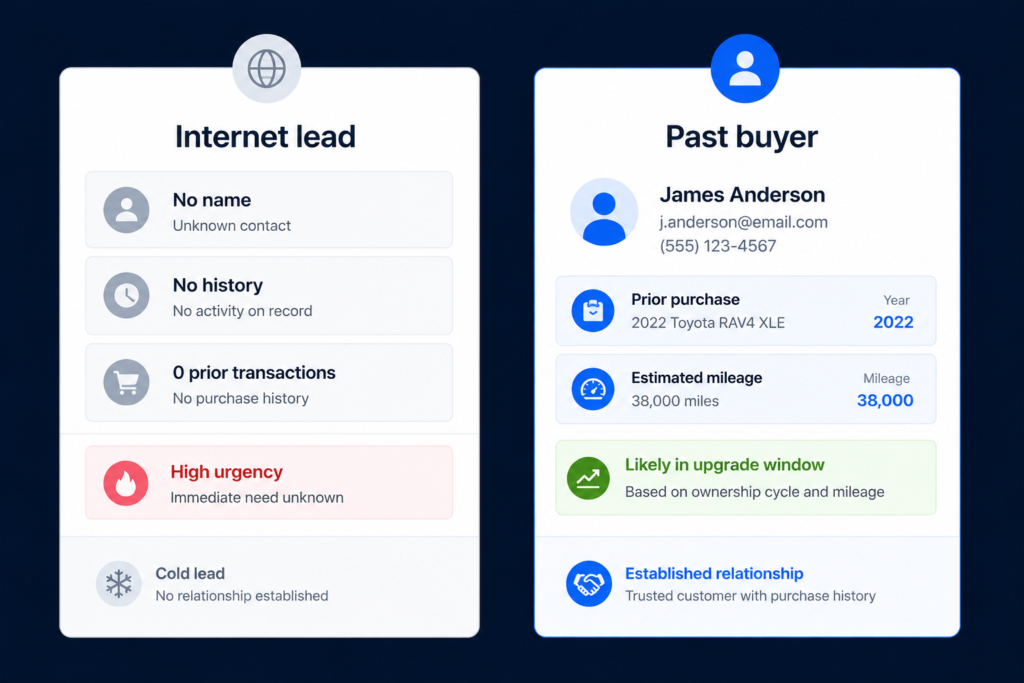
A lead is someone whose relationship with your dealership is zero. They expressed some level of purchase intent by submitting a form or calling in, but they have no history with you, no reason to trust you specifically, and no established loyalty to activate. Converting them requires building a relationship from scratch.
A past buyer already chose you. They went through the whole purchase process, they handed over their keys and their money, and they drove away in a vehicle from your store. The relationship exists. What they need from you is not a sales pitch. It is a timely, relevant, credible contact that says you are thinking about them and you have something worth their time.
That is a fundamentally different conversation. It does not require the same urgency, the same script, or the same close-rate pressure as a cold internet lead. It requires patience, relevance, and consistency: reaching the right person at the right point in their ownership cycle with a message that actually reflects what they are likely thinking about their current vehicle.
When you run that conversation through an inbound-trained BDC with a cold-lead urgency model, you get outcomes that underperform what the relationship actually supports. The gross numbers that result from a proactively worked past buyer reflect a transaction dynamic that is structurally different from a cold inbound lead. But only if the outreach itself reflects that difference.
Where Autonomous AI Outreach Fits
The answer to a capacity problem is not always more headcount. In this case, adding BDC reps to solve the past buyer outreach gap does not fix the structural mismatch. It just adds cost to a model that is already misaligned with the job.
What the job actually requires is a system that can run a consistent, personalized outreach cadence across thousands of past buyers simultaneously, without competing for the same capacity as inbound lead response, without deprioritizing when the phone starts ringing, and without the turnover and retraining costs that come with a human team running at volume.
Autonomous AI outreach handles the full motion: identifying upgrade-eligible past buyers from CRM data, initiating contact via SMS and email, managing the conversation through objections and appraisal requests, and booking the appointment. The BDC receives a warm appointment from a past buyer who has already been through the qualifying conversation and confirmed their interest, rather than a raw outreach task that may or may not convert after multiple follow-up attempts.
This is not a replacement for the BDC. It is a capacity expansion for a job the BDC was never designed to do at scale. The BDC handles inbound. The AI handles past buyer outreach. The two motions run in parallel, neither one competing for the other’s capacity.
The result for dealers running this model: consistent monthly trade-in appointment volume from past buyers, generated without additional BDC headcount, without campaign management overhead, and without the inconsistency that comes from assigning outbound work as a secondary task to an inbound-focused team.
Koons Motors generates 53 trade-in appointments per month from their past buyers this way, generating $190,000 in monthly gross from a sourcing channel that runs independently of their BDC capacity. Across single-rooftop dealers running the same model, monthly volume ranges from 6 to 27 appointments, at an average gross of $3,585 per trade.
A Diagnostic for Your Own Operation
Before drawing conclusions about whether your BDC has this capacity gap, it is worth running the actual numbers on your operation rather than relying on assumptions.
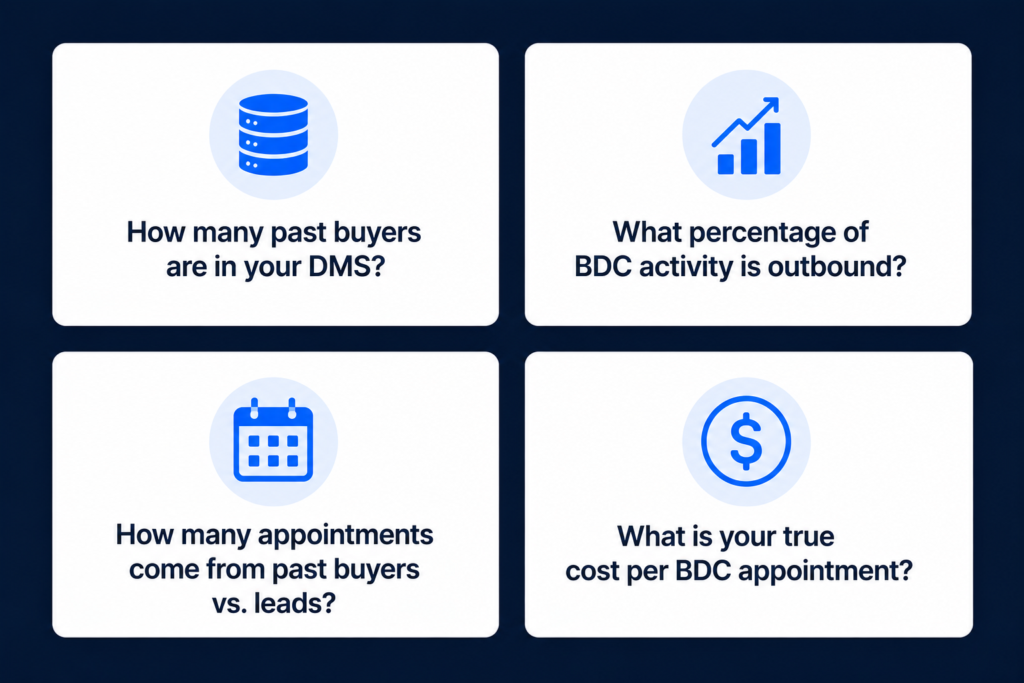
How many past buyers are in your DMS? Not total contacts. Past buyers specifically. The customers who completed a transaction with your store, whose contact information is valid, and whose vehicle is likely approaching the upgrade window. If you do not have a clean answer to that question, the first issue is data quality, not outreach strategy.
What percentage of your BDC’s current activity is outbound to past buyers versus inbound response? Pull a 90-day sample. Most dealers who run this exercise find that outbound to past buyers is a small fraction of total BDC activity, often under 10 percent, because the inbound queue absorbs most available capacity.
What is your current appointment volume from past buyers versus cold leads? If you are tracking this by source at all, the ratio tells you how much of the available past buyer opportunity you are actually capturing. If you are not tracking it by source, that is the first thing to fix.
What does it cost you to generate a BDC appointment today? The fully loaded BDC cost per appointment covers salary, benefits, training, turnover, management overhead, and technology. It is significantly higher than the number most dealers have in their heads. That number changes the ROI math on every alternative sourcing model you evaluate.
Those four questions give you the actual picture of where your BDC is and is not performing on past buyer outreach. The answers also determine whether you are structurally ready to run autonomous outreach alongside your existing BDC, and what the upside looks like if you do.
What This Category Covers
The posts in this category go deep on each piece of the capacity problem and what it takes to close the gap.
Most Dealers Have No Idea What a BDC Appointment Actually Costs Them walks through the fully loaded cost math on base salary, benefits, turnover, training, management, and technology, and what that number means for how you evaluate any alternative.
Your BDC Was Built for Inbound. That’s the Problem. makes the structural diagnosis explicit: not a performance failure, a design mismatch.
Your Past Buyers Are Shopping Right Now. Are You Reaching Them First? covers the ownership cycle window and the competitive urgency behind getting there before someone else does.
This Isn’t About Replacing Your BDC. It’s About What Your BDC Can’t Scale. addresses the human-versus-AI framing directly and makes the case for complementary rather than competitive deployment.
Most Dealers Are More AI-Ready Than They Think is the readiness diagnostic on what it actually takes to run autonomous outreach effectively and why the bar is lower than most GMs assume.
Your Past Buyers Aren’t Leads. Stop Treating Them Like They Are. is the reframe piece that ties the whole category together.
The through-line across all of it: the customers sitting in your CRM right now are not a lead generation problem. They are an activation problem. And activation at scale requires a different system than the one you built for inbound.
Find out what your past buyers could produce →
FAQs
Inbound BDC performance covers how quickly and effectively a team responds to leads that arrive through internet forms, phone, and chat. Outbound past buyer outreach is a proactive motion: identifying customers whose ownership profile suggests they are in the upgrade window, initiating contact, managing the conversation, and booking the appointment. The two jobs require different skills, different pacing, and different operational models. Assigning both to the same team without accounting for the capacity difference is the most common reason dealers underperform on past buyer outreach.
It is a capacity and prioritization issue, not a skills issue. Inbound leads have urgency signals. Response time is tracked, managers watch it, reps feel the pressure to respond immediately. Past buyer outreach does not have that same urgency signal, so it gets deprioritized when the inbound queue is full. The outreach that does happen is inconsistent enough that it does not produce reliable appointment volume.
Industry data suggests 15 to 30 percent of a typical franchise dealer’s past buyer base is within the vehicle ownership upgrade cycle at any given time, meaning their vehicle age, mileage, and equity position make them realistic trade candidates today. On a DMS with 8,000 past buyers, that is 1,200 to 2,400 active outreach candidates. Most dealers are reaching a small fraction of that population consistently.
No. Autonomous AI outreach handles the past buyer outreach motion: identification, contact initiation, conversation management, appraisal, and appointment booking. That frees the BDC to focus on what it does well, converting warm inbound leads and managing the customer experience once an appointment is set. The two functions run in parallel without competing for the same capacity.
A systematic past buyer outreach program using autonomous AI runs at a fixed monthly cost that does not scale per contact or per appointment. Against a fully loaded BDC cost per appointment that typically runs significantly higher than most dealers track, the per-appointment economics of autonomous outreach improve materially as monthly volume increases. The full cost comparison is covered in Most Dealers Have No Idea What a BDC Appointment Actually Costs Them.
Single-rooftop franchise dealers running autonomous past buyer outreach typically generate 6 to 27 trade-in appointments per month from their existing customer base, at an average gross of approximately $3,585 per trade. At the dealer group level, Koons Motors generates 53 appointments per month and $190,000 in monthly gross from the same model running across multiple rooftops.
In this category:
- Most Dealers Have No Idea What a BDC Appointment Actually Costs Them
- Your BDC Was Built for Inbound. That’s the Problem.
- Your Past Buyers Are Shopping Right Now. Are You Reaching Them First?
- This Isn’t About Replacing Your BDC. It’s About What Your BDC Can’t Scale.
- Most Dealers Are More AI-Ready Than They Think
- Your Past Buyers Aren’t Leads. Stop Treating Them Like They Are.
Further reading: