
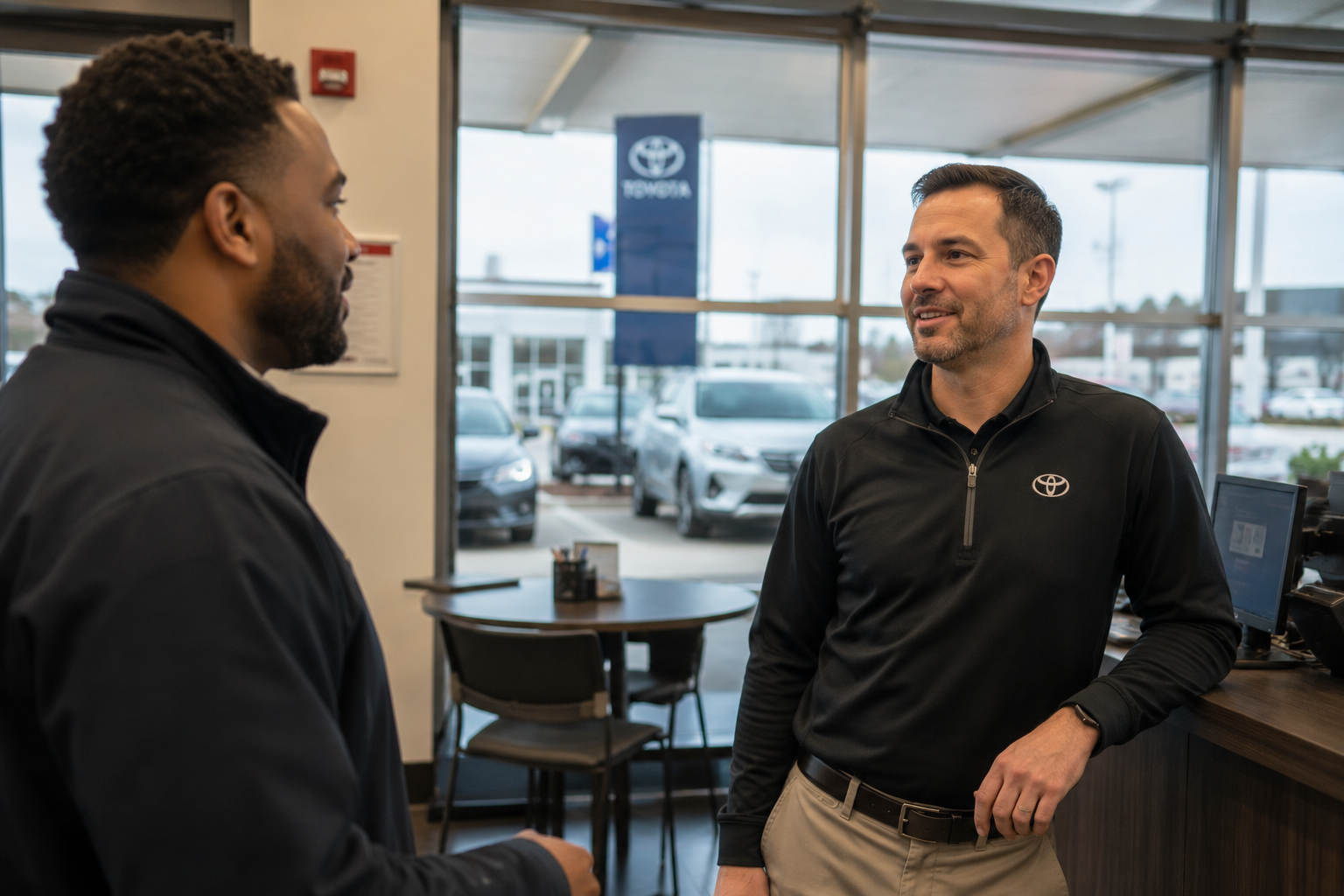
Most dealership outreach programs are built around a lead model. A contact enters the system, gets assigned a status, moves through a follow-up sequence, and is measured by whether it converts to an appointment. The rep’s job is to turn a contact into a booking. The urgency is high. The frame is transactional.
That model works well for cold leads. It is the wrong model for past buyers.
The distinction sounds simple. It has significant operational consequences that most dealers have not fully thought through, and it explains a lot of the underperformance dealers see when they try to run past buyer outreach through the same system they use for inbound lead conversion.
What Makes a Lead a Lead
A lead is a contact whose relationship with your store is zero or near zero. They filled out a form, clicked an ad, called from a search result, or walked in off the street. They have expressed some level of interest in a vehicle, but they have no history with you, no prior transaction, no accumulated trust. From their perspective, you are one of several options they are evaluating.
Converting that contact into a buyer requires building a relationship from scratch. The outreach is about establishing credibility, creating urgency, and differentiating your store from the competitors they are also talking to. The rep’s job is essentially to earn the right to the transaction.
The metrics that matter for leads reflect this: response speed, contact rate, follow-up persistence, and close rate. The model is built around conversion from zero.
None of that applies to a past buyer.
What Makes a Past Buyer Different
A past buyer has already done the thing a lead has not done yet. They chose you. They went through the research, the comparison, the negotiation, and the paperwork, and at the end of all of it, they handed over their money and drove away in a vehicle from your store.
That history changes everything about the outreach dynamic.
They do not need to be convinced you are credible. They already know you are. They have direct personal experience with your store, your process, and your people. That experience is either an asset or a liability depending on how it went, but it is never neutral. There is no starting from zero.
They are not comparing you to three other dealers right now. Unless they have already started an active search, they have no competing offers in their pocket. They are living their life, thinking about other things, and your outreach is going to land in a context where no one else is competing for their attention yet.
They are not a conversion target. They are a re-engagement opportunity. The goal is not to persuade them to consider doing something they have never done before. The goal is to reach them at the right moment in their ownership cycle and remind them that the relationship they already have with your store is the natural starting point for their next transaction.
That is a fundamentally different job than lead conversion. And running it through a lead conversion model produces results that underperform what the relationship actually supports.
The Outreach Model That Fits
When you recognize that a past buyer is not a lead, the outreach model changes in three concrete ways.
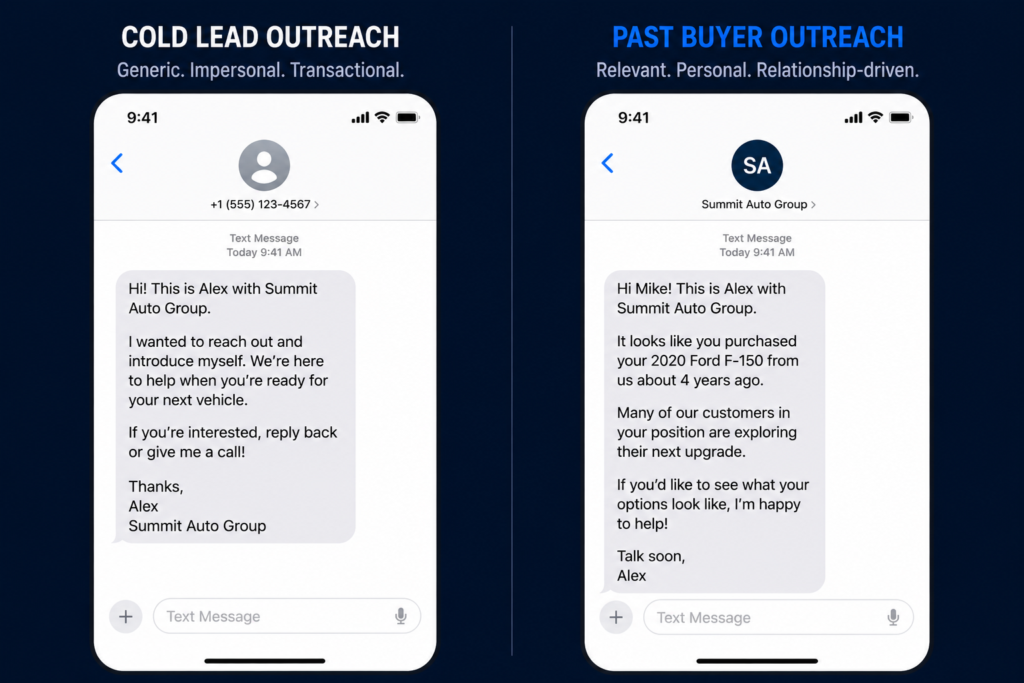
The message is different. A past buyer outreach message does not introduce your store. It acknowledges the existing relationship. It references the vehicle they bought, the time they have owned it, and the reason why now might be a good time to talk about their next one. The relevance is specific, not generic. The tone is familiar, not formal. A past buyer who receives an outreach message that sounds like it was written for a stranger will respond at the rate of a stranger. A past buyer who receives a message that acknowledges who they are and what they have already done with you will respond at a meaningfully higher rate.
The timing is different. Cold lead outreach is reactive to expressed intent. You respond because someone raised their hand. Past buyer outreach is proactive, timed to the ownership cycle rather than to expressed intent. The right time to reach a past buyer is when they are approaching the upgrade window, not after they have already started shopping. As covered in the outreach window post, first contact before active shopping produces a structurally different conversation than contact after a competing offer has already arrived.
The success metric is different. Cold lead conversion is measured by appointment set rate and close rate from a pool of actively shopping contacts. Past buyer outreach is measured by appointment generation from a pool of contacts who were not actively shopping when you reached them. Those two metrics are not directly comparable. A past buyer outreach program that generates 15 appointments per month from a population that had zero purchase intent at the start of the month is producing significant value, even if the raw conversion rate looks lower than a hot inbound lead pool.
Where the Lead Model Breaks Down
The most common failure mode in past buyer outreach programs is this: a dealer decides to work their DMS, assigns the task to the BDC, and runs the outreach through the same sequence they use for inbound leads. High frequency, urgency-driven messaging, short follow-up windows, close-rate pressure.
The past buyers who receive that outreach do not respond like leads. They respond like people being pitched hard by a store they already know. Some of them find it off-putting. Most of them ignore it. A few of them opt out. The dealer concludes that their past buyers do not convert from outreach and moves on.
The problem was never the audience. It was the model.
The BDC structural mismatch explains part of why this happens operationally. But underneath the structural problem is a conceptual one: treating a past buyer outreach program as a lead generation campaign, with lead generation metrics and lead generation urgency, is guaranteed to produce results that look like a poor-performing lead campaign rather than what the channel is actually capable of.
The dealers generating 20, 30, 50 past buyer appointments per month are running a different model. The outreach is personalized to the relationship. The cadence is patient and relevant rather than urgent and generic. The measurement reflects what the channel is actually doing, which is converting a population with zero expressed intent into scheduled appointments at a consistent monthly rate. And the results reflect that difference in the gross those appointments produce, which as the transaction dynamic research shows, runs significantly higher than a lead-generated appointment precisely because the customer arrived without competing offers and without the adversarial dynamic a cold lead conversion creates.
The Reframe That Changes Everything
The categories matter because they determine the system you build, the team you task, the metrics you track, and the message you send.
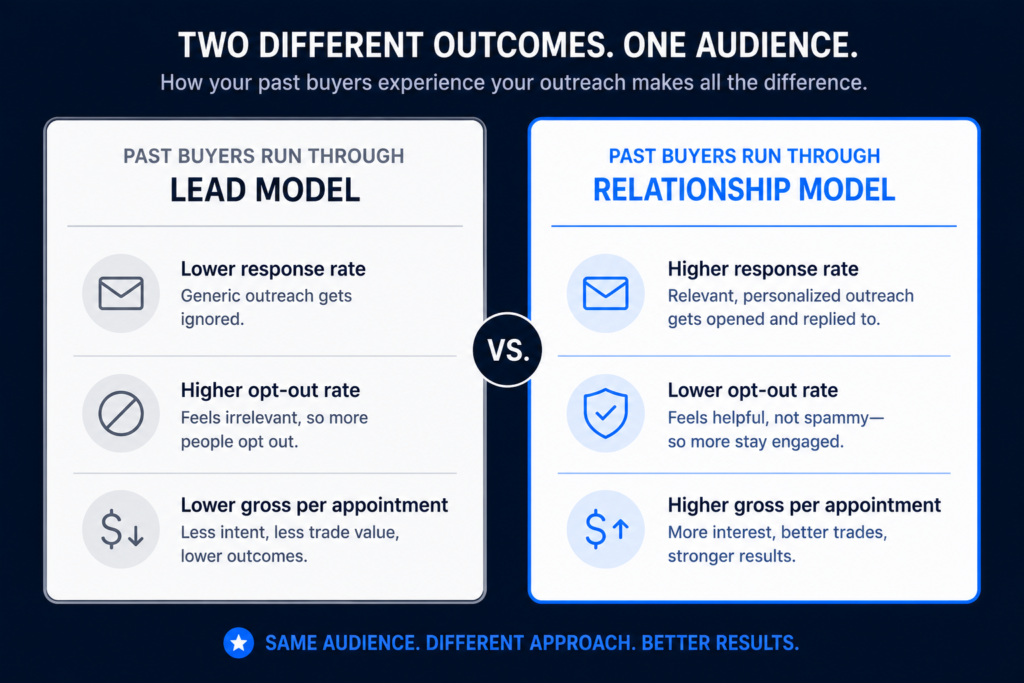
If past buyers are leads, you run them through your lead system. You measure lead metrics. You get lead-level results from a population that should be producing significantly better than that.
If past buyers are an existing customer population that needs a timely, relevant re-engagement at the right point in their ownership cycle, you build a different system. You design messaging that acknowledges the relationship. You time the outreach to the upgrade window rather than to expressed intent. You measure appointment generation from a non-shopping population, which is the right metric. And you route the results to a follow-up process designed for a warm past buyer appointment rather than a generic inbound lead.
That reframe is the underlying logic behind every post in this category. The capacity problem is a capacity problem because past buyer outreach is a different job than inbound lead response, not a bigger version of the same job. The cost math changes because the channel economics of a relationship-based outreach model are structurally different from a lead acquisition model. The competitive window is urgent because the relationship advantage erodes the moment a competitor reaches your past buyer first with a credible offer.
Koons Motors generates 53 appointments per month not because they found a more efficient lead source. They generate 53 appointments per month because they are running a relationship re-engagement model at scale against a population that already chose them.
That is a different category of result. It starts with a different category of thinking about who is in your DMS.
Find out what your past buyers could produce →
FAQs
A lead is a contact with no prior relationship with your store who has expressed some level of purchase intent. Converting them requires establishing credibility and differentiating from competitors. A past buyer has completed a prior transaction with your store, has direct experience with your brand, and does not need to be introduced to you. The outreach model, the messaging, the timing, and the success metrics are all different for the two populations.
Lead conversion models are built for urgency, high-frequency follow-up, and close-rate pressure against actively shopping contacts. Past buyers who are not in an active shopping mindset respond to that model the way anyone responds to being pitched hard by someone they already know: with lower engagement than a genuine relationship-based re-engagement would produce. The mismatch between the model and the audience produces results that look like a poor-performing lead campaign when the actual potential of the audience is significantly higher.
Past buyer outreach should be measured by appointment generation from a non-shopping population, not by conversion rate from expressed intent. A program that generates 15 appointments per month from contacts who had no active purchase intent at the start of the month is performing well by the right metric, even if its raw conversion rate looks lower than a hot inbound lead pool. The downstream metric that matters is gross per appointment, which for past buyer outreach runs significantly higher than for lead-generated appointments.
A past buyer outreach message acknowledges the prior relationship: it references the vehicle the customer bought, the time they have owned it, and a specific reason why now might be a natural time to consider trading. It does not introduce the dealership as if for the first time. The tone is familiar and relevant rather than formal and generic. Past buyers who receive messaging calibrated to their actual relationship with the store respond at measurably higher rates than past buyers who receive generic lead-style outreach.
The relationship advantage is strongest in the period before a past buyer has started active shopping elsewhere. Once a competing offer has been received and the customer has begun an active comparison process, the advantage narrows significantly. This is why the timing of outreach relative to the upgrade window matters as much as the content and model of the outreach itself. The combination of the right timing and the right relationship-aware model is what produces the gross premium documented in the complementary model research.
Related reading:
- Your BDC Has a Capacity Problem. Your Past Buyers Are Paying for It.
- Most Dealers Have No Idea What a BDC Appointment Actually Costs Them
- Your BDC Was Built for Inbound. That’s the Problem.
- Your Past Buyers Are Shopping Right Now. Are You Reaching Them First?
- This Isn’t About Replacing Your BDC. It’s About What Your BDC Can’t Scale.
- Most Dealers Are More AI-Ready Than They Think
- Your Own Customers Are Your Highest-Margin Inventory Source. Here’s the Math.
- Where Dealer Gross Actually Comes From in 2026