Somewhere in your DMS right now there are customers who bought a vehicle from you in 2021 or 2022. Their vehicle is three to four years old. The warranty is approaching its end or already past it. The mileage is climbing toward the point where maintenance costs start to feel less predictable. Their equity position, depending on when they bought and what they paid, may be favorable.
These customers are not thinking about buying a car today. But they are moving through the part of the ownership cycle where that thought starts to take shape. Something will trigger it, a repair estimate, a conversation at work, a friend who just traded in, and when it does, the dealer who reaches them first with a credible, relevant offer has a significant advantage over everyone who reaches them second.
The question is not whether those customers will eventually trade. Most of them will. The question is whether you are the one they hear from first.
The Ownership Cycle Math
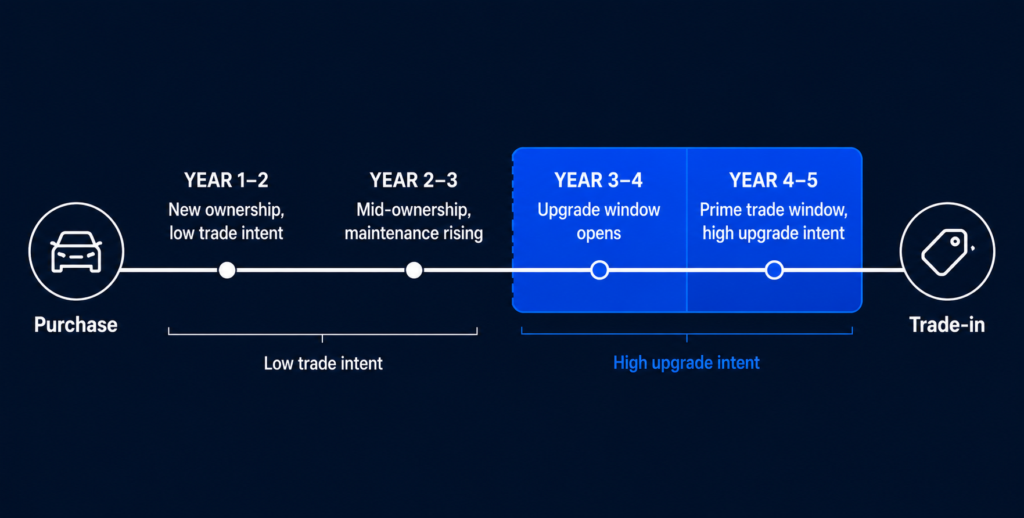
The average new vehicle ownership cycle in the United States runs three to five years. That number has been relatively stable over time, even as vehicle prices and financing terms have shifted. People keep cars longer than they used to in the 1990s, but they do not keep them indefinitely, and the factors that drive a trade decision, warranty expiration, mileage thresholds, equity position, lifestyle changes, follow a reasonably predictable arc.
For a franchise dealer with an active transaction history going back five or more years, this means a rolling segment of past buyers is always in or approaching their upgrade window. The specific size of that segment depends on your transaction volume and the age distribution of your DMS contacts, but for most mid-size franchise dealers, the number is significant.
If your store did 300 new and used transactions a year over the past five years, that is 1,500 past buyers in the DMS. At any given moment, a meaningful portion of those buyers are within the upgrade window. Not all of them will convert. Not all of them have the equity position or the motivation right now. But enough of them are close enough to the window that a well-timed, relevant contact from your store would land on fertile ground.
The dealers who understand this think about their DMS as a rolling pipeline of future trade-in appointments, not a static archive of closed deals. The dealers who do not think about it that way are leaving those appointments for someone else to book.
The Competitive Window Is Not Staying Open
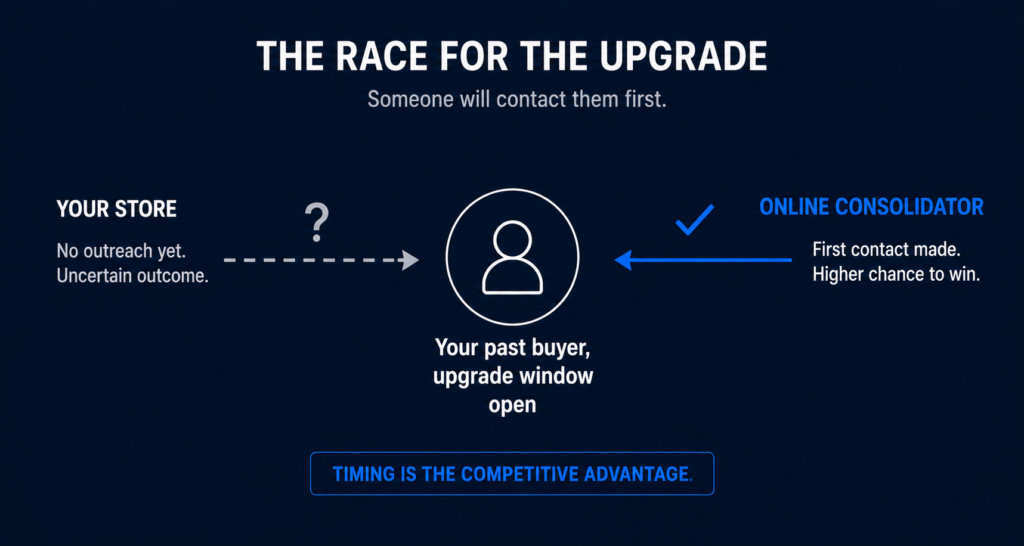
Here is what changes the urgency of this conversation: you are not the only one who knows those customers are in the upgrade window.
The major online vehicle buying platforms, the national consolidators, and an increasing number of well-resourced independent dealers are running systematic outreach programs against consumer vehicle ownership data. They are identifying owners who are approaching the ownership cycle window and reaching out proactively with trade appraisals and purchase offers, often before the customer has walked into a dealership or started an active search.
This outreach is not generic. It is targeted, personalized to the vehicle make, model, and year, and delivered through the channels, primarily SMS and email, where consumers are most responsive. A customer who receives a credible, relevant trade offer and responds to it has started a transaction process. Once that process is in motion elsewhere, the likelihood of bringing them back to your store drops significantly.
The franchise dealer’s structural advantage in this competition is real: a past buyer who bought from you has a relationship with your store, a reason to trust your appraisal over a stranger’s offer, and a natural inclination to return to somewhere familiar. But that advantage only holds if you make contact first. If the customer has already accepted an offer or started the process with a competitor before you reach out, the relationship advantage is largely lost.
First contact in the upgrade window is not everything. But it is a meaningful edge, and it is an edge that erodes every week you are not running systematic outreach to the buyers who are in it right now.
What First Contact Actually Does
There is a practical reason first contact matters beyond the obvious competitive advantage.
When a dealer reaches a past buyer before they have started actively shopping, the conversation starts from a different place. The customer has not yet formed a price anchor from a competitor’s appraisal. They have not yet started comparing options. They have not yet mentally committed to a transaction process elsewhere.
The dealer who initiates that conversation gets to set the frame. They are not responding to a customer who already has a number in their pocket. They are introducing the possibility of a trade to someone who was not thinking about it today and who will, if the outreach is relevant and the timing is right, respond with genuine interest.
That is the transaction dynamic that produces the gross premium on a proactively sourced past buyer relative to a reactive appraisal lane walk-in or an auction acquisition. The customer arrived at the conversation on your terms, not theirs. The appraisal happens first. The gross follows.
Contrast that with the customer who has already received two competing offers by the time they call your store. That customer has a number in their head. They know what their vehicle is worth to someone else. Every conversation from that point is a negotiation against an offer you cannot see.
The outreach window is valuable specifically because it exists before that dynamic sets in.
The System Problem
Understanding that the upgrade window exists and that first contact matters does not automatically solve the operational challenge: how do you identify which past buyers are in the window right now, reach them at scale, and do it consistently enough that you are reliably getting there first?
That is the question the BDC capacity problem makes hard to answer through traditional means. A BDC team built for inbound response cannot simultaneously run a consistent, systematic outreach cadence across the full rolling upgrade window population in your DMS. The capacity is not there, and the structural forces that deprioritize past buyer outreach relative to inbound will reassert themselves every time the queue fills up.
The dealers producing consistent monthly past buyer appointment volume solve this by running the outreach motion through a system built specifically for it: one that analyzes the DMS on an ongoing basis, identifies contacts in the upgrade window, initiates and manages the outreach conversation autonomously, and books the appointment without requiring BDC capacity to do it.
That is how Koons Motors reaches 53 trade-in appointments per month from past buyers. Not by working harder on outreach, but by having a system that runs the outreach motion consistently while the BDC handles inbound.
The upgrade window in your DMS is open right now. The contacts are there. The question is whether your outreach gets there first.
Find out what your past buyers could produce →
FAQs
The primary indicators are vehicle age (3 to 5 years from purchase date), estimated mileage, and equity position. Most franchise dealer DMS systems contain the purchase date and original vehicle information for past buyers. Layering in estimated mileage based on average annual driving data and current market values for the vehicle gives a reasonable picture of which contacts are in the window. Autonomous outreach systems do this analysis on an ongoing basis rather than as a periodic manual exercise.
The average new vehicle ownership cycle in the United States runs three to five years, with variation by segment, income level, and geography. Truck and SUV buyers tend to hold longer. Luxury buyers turn more frequently. For most franchise dealers, applying a three-to-five year window to past transaction data gives a reasonable approximation of the current upgrade-eligible population.
First contact before a customer has started actively shopping allows the dealer to initiate the appraisal conversation without competing against a pre-formed price anchor from another offer. Customers who have already received competing appraisals before contacting your store negotiate from a known reference point you cannot see. First contact produces a structurally different conversation and, as a result, materially different gross outcomes.
Major online vehicle buying platforms and national consolidators run systematic outreach programs using vehicle ownership data and consumer contact information. They identify owners approaching the upgrade window and contact them proactively with trade appraisals and purchase offers. This is not hypothetical. It is an operational reality that has been running at scale for several years and that continues to grow as more technology investment flows into vehicle acquisition.
This varies by transaction volume and DMS history, but for a franchise dealer who has been operating for five or more years at a typical mid-market volume, the upgrade-eligible population at any given time is a meaningful portion of the total past buyer base. Industry data on ownership cycles suggests 15 to 30 percent of past buyers are within the upgrade window at any given point. For a store with 1,500 past buyers in the DMS, that is 225 to 450 active outreach candidates right now.
Related reading:
- Your BDC Has a Capacity Problem. Your Past Buyers Are Paying for It.
- Most Dealers Have No Idea What a BDC Appointment Actually Costs Them
- Your BDC Was Built for Inbound. That’s the Problem.
- Your Own Customers Are Your Highest-Margin Inventory Source. Here’s the Math.
- How Koons Motors Gets 53 Trade-Ins a Month From Customers They Already Have
- Front-End Gross Is Compressed. Here’s Where Dealers Are Finding Margin Instead.
- Where Dealer Gross Actually Comes From in 2026