


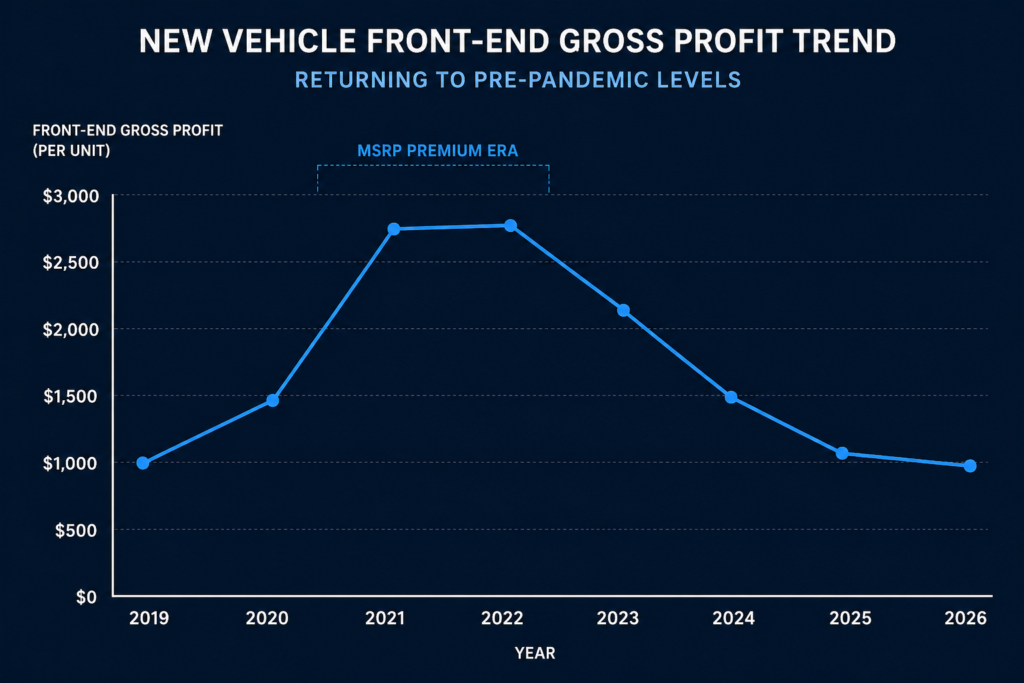
For about three years, the math was unusually simple. Inventory was short, demand was high, and franchise dealers were retailing new vehicles at or above MSRP with minimal effort. Front-end gross that used to require real negotiation skill and inventory discipline was showing up automatically.
That era is over.
New car front-end gross has compressed materially as inventory normalized and consumer pricing expectations reset. The dealers who built their profitability model around pandemic-era margins are now running the same operations against a fundamentally different P&L.
The question isn’t whether this happened — it did. The question is where gross comes from now, and which dealers have already figured it out.
What Changed and Why It’s Permanent
The MSRP premium era was a supply shock, not a structural shift. When chip shortages and production disruptions cut new vehicle inventory to a fraction of normal levels, dealers held pricing power they hadn’t seen in a generation. Above-sticker deals on mainstream vehicles. Minimal incentive pressure. Front-end gross that required almost no discounting to achieve.
Two things have since reversed:
Inventory is back. New vehicle supply has normalized across most franchises. Days supply is back in a range where consumers have options, and dealers are competing for buyers again. The leverage has shifted.
Consumer expectations reset — in both directions. Buyers who paid over MSRP during the shortage know what the market looks like now. They’re negotiating again. At the same time, the dealers who held pricing through the shortage built real goodwill with customers they treated fairly — and lost goodwill with those they didn’t. That plays out in repeat and referral business over the next several years.
The net result: new vehicle front-end gross is back to a range that requires disciplined operations to sustain, not just favorable market conditions. For many dealers, that means the profitability they were accustomed to seeing on the new side no longer materializes the same way.
Where the Gross Is Going Instead
The dealers outperforming their markets on profitability right now aren’t doing it by squeezing more front-end out of new vehicle deals. They’re doing it by building gross on the used side — specifically on used vehicles sourced at lower cost with higher margin than the auction dependency model produces.
Here’s why used vehicle gross is the lever that moves the P&L in a compressed new car market:
Used gross is structurally higher per unit when sourced correctly. A trade-in from a proactive outreach to a past buyer in your database produces approximately $5,000 in average front-end gross. That’s not a new car unit where you’re negotiating against published MSRP and competitive dealer pricing. That’s a used vehicle transaction where you control the appraisal conversation, know the vehicle history, and are working with a customer who came in specifically because you reached out. The gross is there because the acquisition economics are different.
Used volume is controllable in a way new vehicle volume isn’t. You can’t manufacture new vehicle demand. You can, however, proactively contact upgrade-eligible customers in your own database and create used inventory acquisition volume that doesn’t depend on market conditions, manufacturer incentives, or what your competitors are doing. That controllability is worth a significant premium in a compressed margin environment.
The trade-in customer buys a new or CPO vehicle. This is the multiplier effect that the straight used gross number understates. A customer who comes in to trade their three-year-old vehicle isn’t just generating used inventory gross — they’re almost always buying a replacement. The used acquisition appointment is simultaneously a new or CPO vehicle sales opportunity. In a market where new front-end is compressed, that incremental new deal — which you wouldn’t have had without the proactive outreach — is pure upside.
The Dealers Who’ve Already Made the Shift
This isn’t theoretical. The franchise dealers who have rebuilt their profitability model post-MSRP-era share a common operational characteristic: they’ve made used vehicle acquisition from their own customer database a deliberate, systematic process rather than a reactive one.
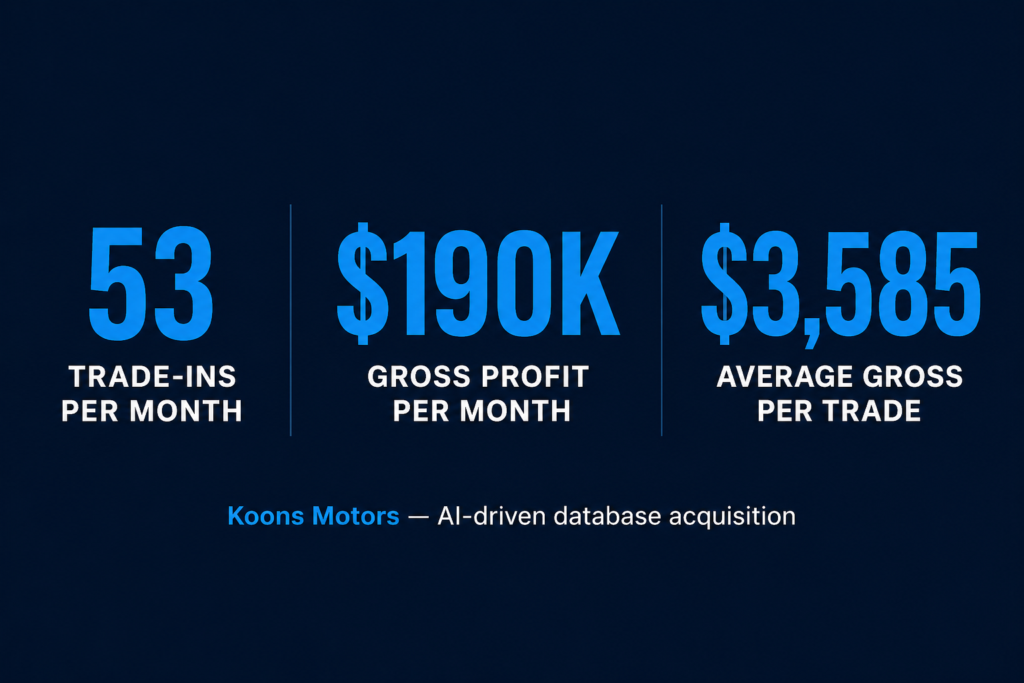
The Koons Motors group generates 53 trade-in appointments per month from their existing customer database — producing $190,000 in gross profit monthly. That’s not a lucky market or an unusually strong franchise. It’s a sourcing system that runs consistently regardless of what new vehicle margins are doing.
Across single-rooftop dealers using the same approach, results range from 6 to 27 trade-ins per month, with average gross per trade running approximately $3,585. For a dealer generating 15 trades a month from their database, that’s $53,775 in monthly gross that didn’t exist before — and that doesn’t move with new car front-end compression.
What This Means for How You Think About the P&L
If you’re a dealer principal looking at your profitability model right now, the new vehicle side of the ledger is largely reactive — you can optimize it, but you can’t manufacture front-end gross that the market isn’t offering. The variables you don’t control (inventory levels, incentive programs, consumer pricing expectations) dominate the outcome.
The used vehicle side, specifically the used vehicle acquisition side, is different. The source of inventory, the cost to acquire it, and the gross it produces are all variables you can influence through operational decisions. In a market where new front-end is compressed, that’s where the P&L leverage lives.
The dealers building durable profitability in 2026 aren’t waiting for the market to shift back. They’re building acquisition systems that produce consistent used gross regardless of what the new car market is doing — and they’re doing it from a source they already own: their own customer database.
The full unit economics breakdown of why database-sourced trade-ins outperform auction by approximately $3,500 per unit in gross is covered in detail in Auction vs. Trade-In: The $3,500 Gross Difference. And if you want to understand what the true all-in cost of an auction unit actually looks like when you account for fees, transport, recon, and floor plan, that’s in The True Cost of Buying Used Cars at Auction.
The short version: the margin is in your database. The question is whether you have a system to get it out.
See what your database could produce →
FAQ
Why has new car front-end gross compressed since 2022? New vehicle front-end gross spiked during 2020–2022 due to inventory shortages caused by semiconductor supply disruptions. As inventory normalized through 2023–2024, consumer pricing power returned and above-MSRP selling became unsustainable across most segments. Dealers are now operating in a market where front-end gross requires active negotiation management rather than benefiting from supply-side leverage.
Where are franchise dealers finding gross profit in a compressed new car market? The dealers outperforming their markets are building gross on the used vehicle side — specifically through proactive trade-in acquisition from their existing customer databases. Database-sourced trade-ins produce significantly higher front-end gross than auction-sourced inventory, at lower acquisition cost, without depending on market conditions.
What is a realistic used vehicle gross profit target for a franchise dealer? Trade-ins sourced proactively from a dealer’s existing customer base average approximately $5,000 in front-end gross, compared to roughly $1,500 for auction-sourced units. Industry benchmarks vary by segment, market, and franchise — but the $3,500 spread between database-sourced and auction-sourced inventory is consistent across dealer types and sizes.
How does used vehicle acquisition affect new vehicle sales? Proactive trade-in outreach creates a dual gross opportunity: the used vehicle acquisition itself, and the replacement vehicle purchase. A customer contacted about trading their current vehicle is typically in the market for a new or CPO replacement — meaning each database outreach appointment generates potential gross on both the used acquisition and the new sale.
Is the MSRP premium era coming back? Most industry analysts consider the 2020–2022 above-MSRP environment a supply-driven anomaly rather than a structural shift. While specific segments and models may carry pricing premiums in tight supply scenarios, franchise dealers building their profitability models around a return to pandemic-era new vehicle margins are taking on significant planning risk.
Related reading: