

Wholesale: September fell harder than a normal fall
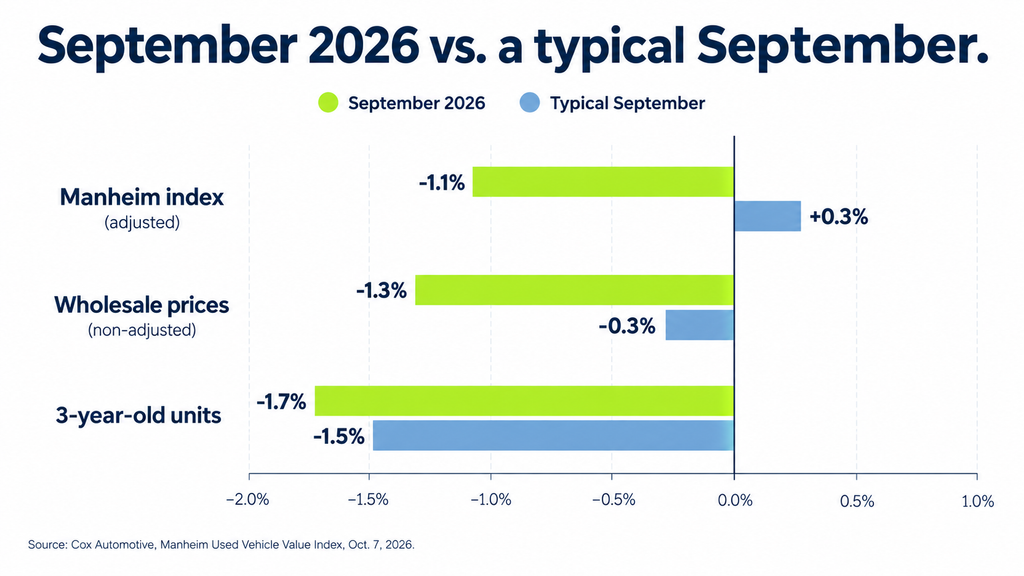
Wholesale values dropped 1.1% from August to 205.9 on the Manheim index, and finished 0.6% below September 2025. That is the first full month this year below the prior year (Cox Automotive, Oct. 7).
For context, the long-term average September move is a 0.3% gain on an adjusted basis. Non-adjusted prices fell 1.3% for the month against a typical 0.3% dip. Three-year-old units lost 1.7% in September, more than the usual 1.5%.
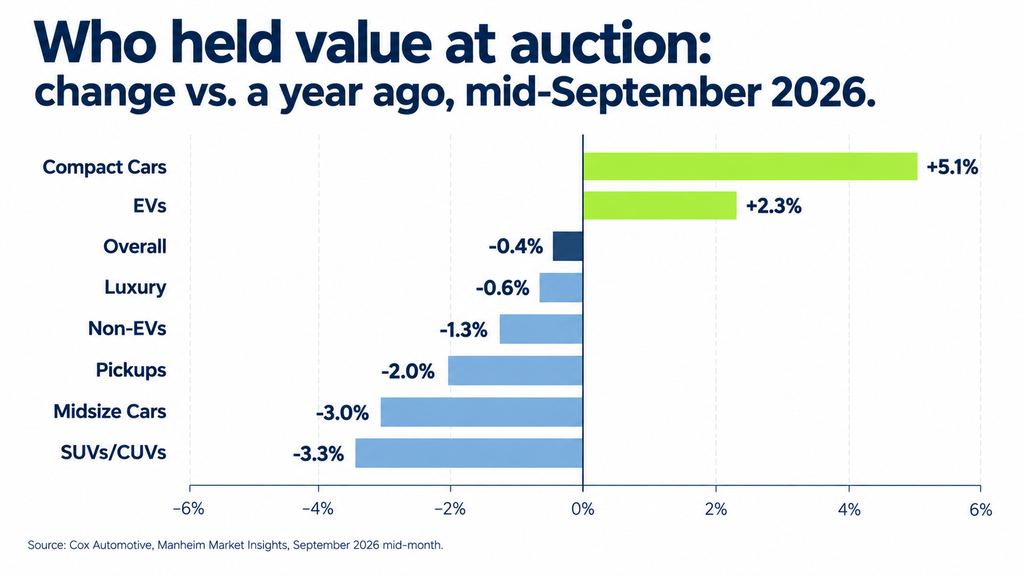
Why it happened, per Cox: diesel at record highs, rising interest rates, falling consumer sentiment, and the first September in decades without an Atlantic hurricane, which normally props up demand. Compact cars and EVs held value. Pickups, SUVs and midsize cars kept sliding.
Cox now expects the index to finish 2026 up only about 0.2%, down from the 2% it forecast in July (Cox Q3 MUVVI release). Wholesale days’ supply ended September at 28, up 2.4 days from a year ago, and auction sales conversion slipped to 55.2%.
What it means for your store: Inventory you buy at auction this quarter is losing value faster than usual while it sits, so acquisition cost and turn time matter more than they did in the spring.
Retail: prices high, affordable cars scarce
Retail listings are not following wholesale down yet. The average used listing price hit $27,239 in August, up 7% from a year earlier and the highest monthly average since December 2022 (Cox Automotive, Sept. 11). Cox’s September inventory report had not been published at press time; we will update this section when it lands.
The squeeze is at the bottom of the market. Used vehicles under $15,000 had just 29 days’ supply in August, 15 days below the industry average. Supply in that band fell 25.9% year over year and now makes up 15.1% of used inventory, down from 20.6% a year ago.
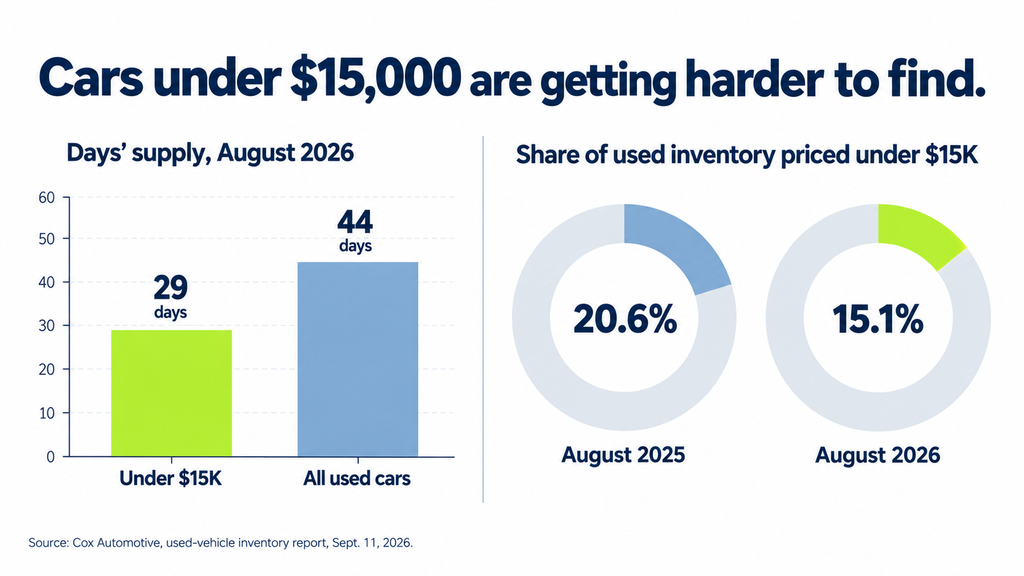
Total supply was 2.13 million units with 44 days’ supply, so the market is not short on cars overall. It is short on the clean, lower-priced cars most shoppers can afford.
What it means for your store: The cars you need most are the hardest to buy at auction. They are also the cars your past buyers are driving right now.
Trade-in equity: two in three owners are above water
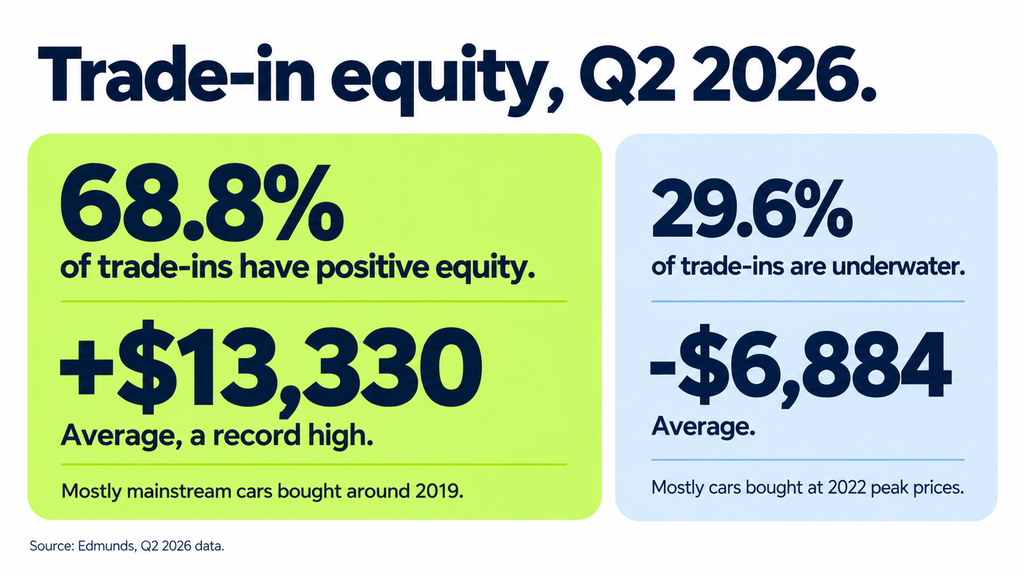
The average positive equity on trade-ins toward new vehicles reached a record $13,330 in Q2 2026, nearly double pre-pandemic levels (Edmunds). 68.8% of trade-ins carried positive equity.
The owners with the most equity are not driving luxury cars. They bought mainstream models like full-size pickups, Camrys, RAV4s, Civics and CR-Vs around 2019 on 60 to 72 month loans and have now cleared the depreciation curve.
The other side of the ledger is real too. 29.6% of Q2 trade-ins were underwater, with an average shortfall of $6,884, mostly on vehicles bought at peak 2022 prices (Edmunds Q2 data via CarPro). Edmunds’ Q3 numbers are expected mid-October; we will add them when they publish.
What it means for your store: Most of your past buyers from 2018 to 2020 are sitting on usable equity. A fall in wholesale values chips away at that equity every month, which gives you an honest reason to reach out now rather than in spring.
New sales are steady; dealer confidence is not
New-vehicle demand keeps surprising to the upside. September’s sales pace came in at 16.0 million, down 3.6% from a year ago, with the year-to-date pace at 16.1 million (CBT News, Oct. 6). Cox raised its full-year forecast to 16.1 million units from 15.8 million (Cox Automotive, Sept. 24).
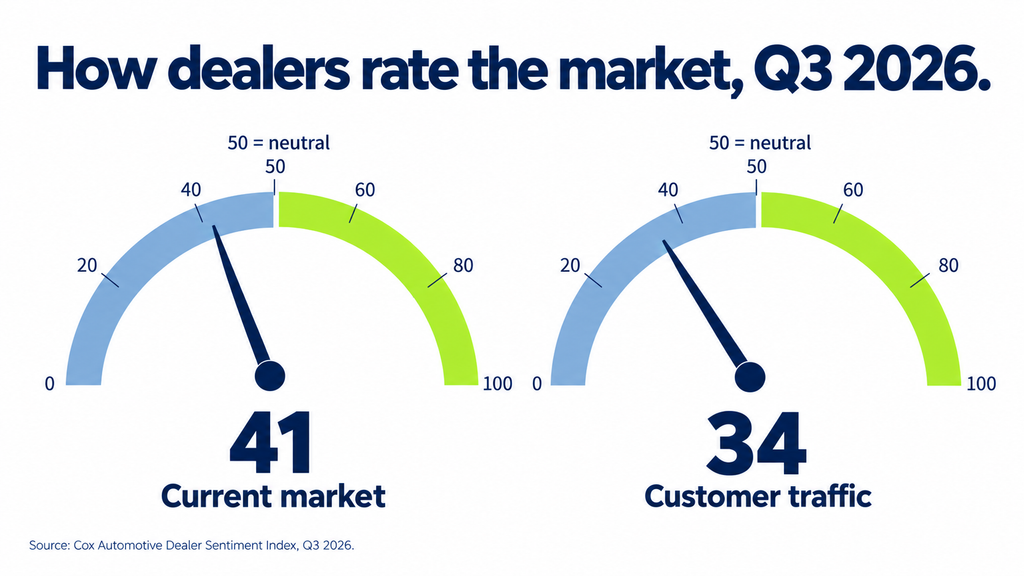
Dealers do not feel it on the floor. In Cox’s Q3 Dealer Sentiment Index, the current-market reading fell to 41 and customer traffic fell to 34, both well under the 50 line that separates good from bad (Cox Automotive Q3 CADSI). Dealers named lower-priced used inventory as a sourcing problem, and listed advertising among their top cost pressures.
Add a Federal Reserve rate hike in September, gas above $4, and diesel at record highs, and Q4 looks like a quarter where shoppers are fewer and more careful.
What it means for your store: Waiting for traffic to come to you is getting more expensive. The customers you already have are the cheapest ones to reach.
Compliance watch: texting rules shifted twice in two weeks
On September 30, the FCC adopted FCC 26-67, rewriting how opt-outs work under the TCPA (Manatt). The changes take effect 30 days after publication in the Federal Register, which had not happened at press time (Day Pitney).
- Informational texts: a STOP can now be applied to the category of message it answered, instead of every message from the sender.
- Marketing texts: nothing loosened. A STOP to a sales or marketing text still revokes consent for all future marketing texts from that sender (RecordingLaw summary of FCC 26-67).
- Exclusive opt-out methods: senders may now designate specific ways to opt out, such as an automated keyword reply.

Nine days earlier, a federal court let a TCPA case against a dealership move forward after the store kept texting a customer who had replied STOP, including a question about a call regarding his current vehicle. The court said a text can serve a “dual purpose” and still count as marketing (National Law Review).
What it means for your store: Treat any text that mentions a customer’s current vehicle, a trade or an upgrade as marketing. Honor STOP on the first request, every time, across every tool that texts your customers. This is general information, not legal advice; check your program with counsel.
October’s playbook: buy the cars that are holding value
September’s data points to four specific moves for the next 30 days.
- Shift acquisition toward compact and fuel-efficient cars. They are the segments still above last year at auction, and $4 gas is keeping retail demand for them high. Look first at past buyers driving 2018 to 2020 Civics, Accords and Camrys, which are among the most common positive-equity trade-ins on Edmunds’ Q2 list.
- Be careful with trucks, SUVs and diesels. These segments led September’s decline, and diesel days’ supply is rising fast. Appraise them against this month’s values, not last quarter’s, and move aging units on your lot before winter.
- Target the 2018 to 2020 cohort, not 2022 buyers. Edmunds’ data shows the owners with record equity bought around 2019, while the average underwater trade is about four years old, bought at peak 2022 prices.
- Fix your opt-out handling before the new FCC rules take effect. They kick in 30 days after Federal Register publication, so that clock could start any day.
That is what we build at inride. Trade Agent AI finds the past buyers in your DMS who are ready to trade and books the appointment; up to 40% of past buyers respond. At Koons Motors, it produced $190,633 in combined profit across three rooftops in three months. Trade Agent Acquire works every trade-in lead on your website in seconds, 24/7.
Book a call to see what your past buyers could produce this quarter.
Sources
- Manheim Used Vehicle Value Index: September 2026 Trends, Cox Automotive, Oct. 7, 2026
- Q3 2026 Manheim Used Vehicle Value Index press release, Cox Automotive, Oct. 7, 2026
- Used-Vehicle Prices Reach Highest Level Since 2022 as Inventory Tightens in August, Cox Automotive, Sept. 11, 2026
- Record positive trade-in equity, Edmunds, Q2 2026 data
- Edmunds Q2 2026 negative equity data, CarPro, July 27, 2026
- September 2026 new-vehicle sales forecast, Cox Automotive, Sept. 24, 2026
- September new-vehicle sales pace, CBT News, Oct. 6, 2026
- Q3 2026 Cox Automotive Dealer Sentiment Index, Cox Automotive
- FCC Replaces “Revoke All” Rule, Manatt, Oct. 2026
- The FCC Changes Certain Consent Revocation Rules, Day Pitney, Oct. 2, 2026
- FCC Adopts New TCPA Consent Revocation Rule, RecordingLaw, Oct. 8, 2026
- Dealership text may constitute TCPA marketing, National Law Review, Sept. 2026