
There’s a version of trade-in acquisition that most dealers are already doing: the appraisal lane. A customer walks in, mentions they might want to trade, and the process kicks off from there. That’s reactive — you’re working with whoever shows up.
Then there’s a version most dealers aren’t doing consistently: proactively contacting past buyers in your own database before they walk in — or before a competitor contacts them first. That’s active. And the gross it produces is structurally different from everything else.
This post explains why the source of a trade-in matters as much as the trade-in itself — and why your own customer database is the highest-margin acquisition channel available to you.
All Trade-Ins Are Not Created Equal
It’s tempting to think of used vehicle gross as a function of the vehicle: what’s it worth, what can I get for it, what’s the spread. But gross is also a function of the transaction dynamic — who has leverage, how much either party knows, and what motivated the customer to come in.
Those variables look very different depending on where the trade-in comes from.
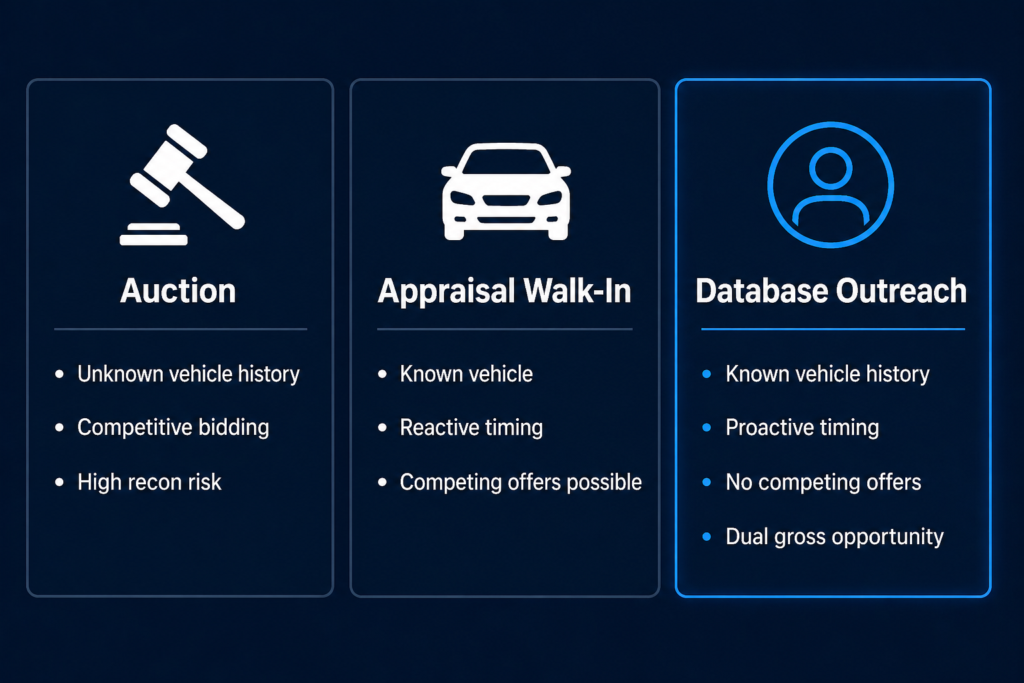
Auction: You’re bidding against other dealers in a competitive lane with incomplete information. You have a condition report, not a service history. You’re committing capital before you know the full recon picture. As covered in What Does a Used Car Actually Cost You?, the true all-in cost of an auction unit typically runs $1,800–$2,500 above the buy price before the vehicle is retail-ready.
Appraisal lane walk-in: Better than auction — you know the vehicle, you can inspect it, and the customer is already in your building. But this is still reactive. You didn’t create this opportunity. The customer decided to come in on their own timeline, possibly after already getting an offer from CarMax or a competing dealer. You’re often negotiating against an outside appraisal you can’t see.
Proactive database outreach — past buyer: This is the different transaction entirely. You identified this customer from your own records. You reached out to them specifically because their ownership profile suggested they’re in the upgrade window. They came in because you contacted them — not because they were already shopping. The dynamic is inverted.
Why the Transaction Dynamic Changes the Gross
When you contact a past buyer proactively, several things happen that don’t happen in a reactive trade-in:
You set the frame. The customer wasn’t shopping — you created the occasion. That means you’re not responding to their timeline or their outside offer. You’re starting the conversation, which gives you more control over where it goes.
You know the vehicle. This customer bought from you. You likely have service records, you know the ownership history, you can estimate recon before you’ve committed to a trade value. That predictability is worth real money — it’s the difference between a $1,100 average recon and a $1,800 surprise.
There’s no competing appraisal in their pocket. A customer who came in because you proactively reached out hasn’t spent the morning getting offers from three other dealers. You’re not matching or beating a number you can’t see. You’re doing the appraisal first.
They’re buying something. A customer in their upgrade window who comes in to trade is almost always buying a replacement vehicle. You’re not just acquiring used inventory — you’re generating a sales appointment. That dual gross opportunity is what makes the database trade-in the most valuable acquisition channel on the board.
The result: average front-end gross on a trade-in sourced from proactive database outreach runs approximately $5,000 — more than three times what an auction unit produces after you account for the full cost stack.
What Makes a Customer Upgrade-Eligible
Not every past buyer is a trade-in opportunity right now. But a significant percentage of your database is — and identifying them is the first step in making proactive outreach a reliable sourcing channel.
The factors that indicate upgrade eligibility:
Vehicle age and ownership cycle. The average new vehicle ownership cycle runs 3–5 years. A customer who bought a 2021 or 2022 model year vehicle from you is in or approaching their natural upgrade window right now. That’s a significant portion of any active database.
Equity position. A customer with positive equity in their current vehicle has a financial reason to trade. As vehicle values have normalized from pandemic highs, some customers who bought at peak pricing may be in tighter equity positions — but customers who bought at normal pricing and have been making payments have likely built equity that makes a trade financially attractive.
Mileage and lifecycle signals. High-mileage customers approaching warranty expiration, customers whose vehicles are aging out of CPO programs, or customers with documented service needs are all natural trade candidates.
Life change indicators. Growing family, job change, or relocation signals in your CRM data can indicate a vehicle upgrade need that hasn’t surfaced yet as active shopping behavior.
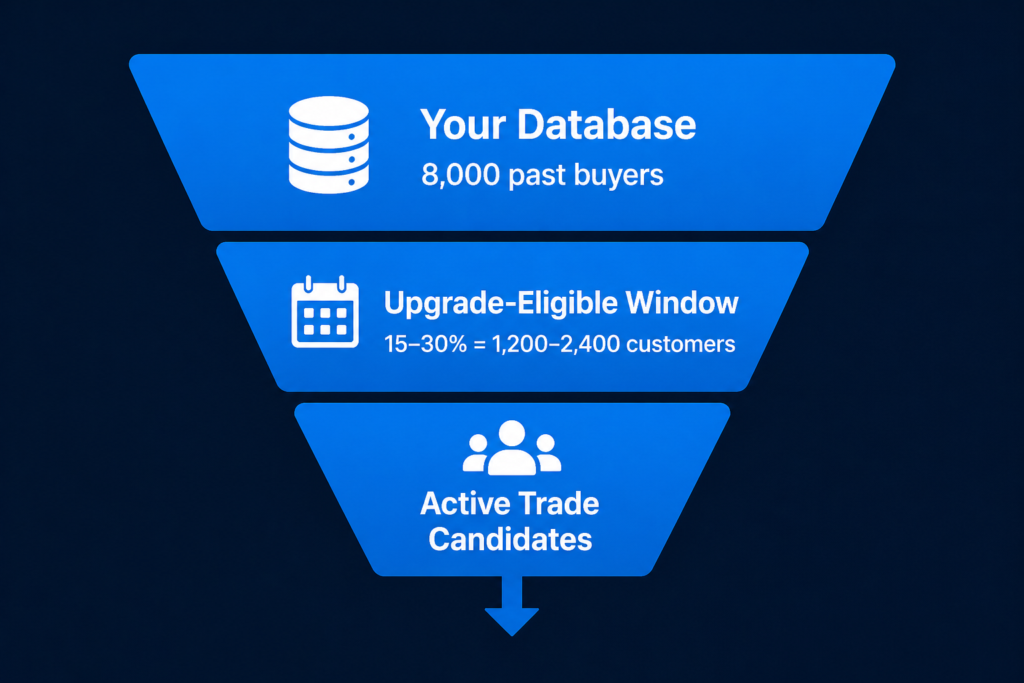
Industry data suggests 15–30% of a typical dealer database is upgrade-eligible at any given time. On a database of 8,000 past buyers, that’s 1,200–2,400 potential trade-in conversations waiting to happen — most of which will never happen if you wait for them to walk in on their own.
The Consistency Problem — and What Solves It
The reason most dealers aren’t systematically generating trade-ins from their own database isn’t that they don’t know the opportunity exists. It’s that the operational motion required — identifying upgrade-eligible customers, reaching out at scale, handling conversations, booking appointments — is inconsistent when run through a traditional BDC.
BDC teams are set up for inbound lead response, not proactive database mining. The outreach cadence, follow-up discipline, and conversation handling that database trade-in acquisition requires is a different motion entirely — and one that BDC teams aren’t typically incentivized, trained, or staffed to run consistently.
The dealers generating 20, 30, 50+ database trade-ins a month aren’t doing it with larger BDC teams. They’re doing it with an autonomous outreach system that identifies upgrade-eligible customers, initiates and manages the conversation via SMS and email, handles objections, generates real-time appraisals, and books the appointment — without requiring BDC involvement.
The result is a sourcing channel that runs consistently regardless of BDC staffing, manager bandwidth, or competing priorities. The front-end gross compression that’s squeezing new vehicle profitability doesn’t touch it — because it’s a used vehicle gross engine that operates independently of market conditions.
See what your database could produce →
FAQ
Why do proactively sourced trade-ins produce more gross than appraisal lane walk-ins? When a dealer proactively contacts a past buyer, they set the frame for the transaction rather than responding to one. The customer hasn’t collected competing appraisals, the timing is dealer-driven, and the vehicle history is known. These factors combine to produce a stronger negotiating position and more predictable recon costs — both of which improve gross relative to a reactive walk-in.
What percentage of a dealer’s database is upgrade-eligible at any given time? Industry data suggests 15–30% of a typical franchise dealer’s customer database is within the vehicle ownership upgrade cycle at any given time. On a database of 8,000 past buyers, that represents 1,200–2,400 potential trade-in candidates — most of whom will purchase elsewhere if not proactively contacted.
How is proactive database outreach different from a standard BDC trade-in campaign? Standard BDC campaigns are typically periodic, manually executed, and inconsistent in follow-up cadence. Proactive database outreach as a systematic channel requires ongoing identification of upgrade-eligible customers, personalized multi-touch outreach via SMS and email, real-time conversation handling, and appointment booking — a motion that traditional BDC teams aren’t structured or incentivized to run consistently.
Does proactive trade-in outreach compete with inbound sales traffic? No — it creates additional traffic. A past buyer contacted about a trade-in who books an appointment is an incremental visit that wouldn’t have happened otherwise. They’re typically in the market for a replacement vehicle, meaning the appointment generates both used acquisition gross and a new or CPO vehicle sales opportunity.
What data do dealers need to identify upgrade-eligible customers? The core data points are vehicle purchase date, model year, estimated current mileage, and equity position. Most franchise dealer CRM systems contain this information for past buyers — the gap is typically in the systematic analysis and outreach cadence, not the underlying data.
Related reading:
- Auction vs. Trade-In: The $3,500 Gross Difference Dealers Are Leaving on the Table
- What Does a Used Car Actually Cost You? The Real Math Behind Auction Dependency
- Front-End Gross Is Compressed. Here’s Where Dealers Are Finding Margin Instead.
- Where Dealer Gross Comes From in 2026: A Franchise Dealer’s Guide to Used Vehicle Margin