

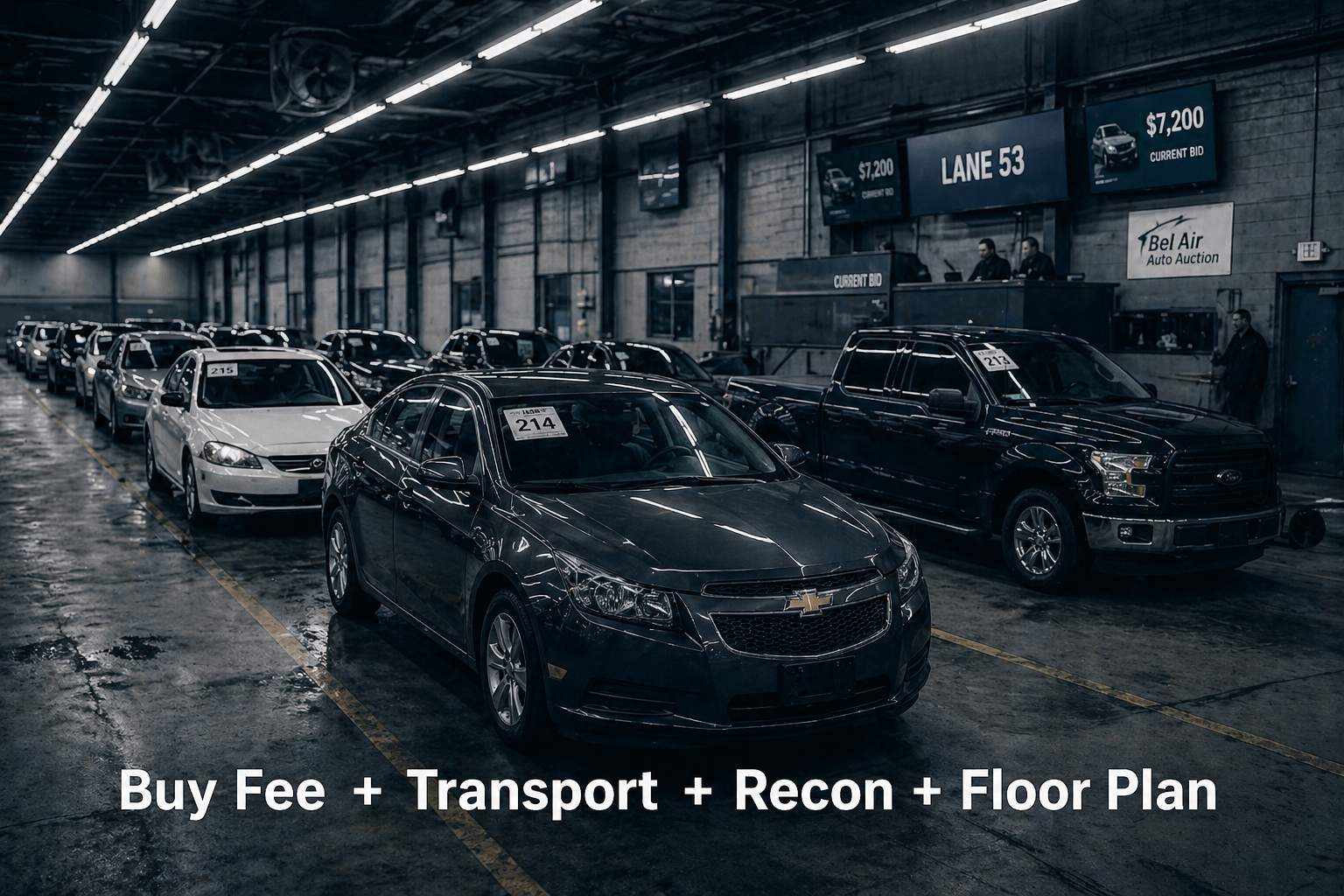
Most dealers have a rough sense that auction is expensive. What most dealers don’t have is a precise number — the actual all-in cost of getting a unit from the auction block to retail-ready on their lot.
That gap between “rough sense” and “precise number” is where margin disappears.
This post builds the full cost model for an auction unit, line by line. Not to argue that auction is always the wrong call — it’s still a legitimate sourcing channel for specific situations. But if you’re treating auction as your default used inventory strategy without knowing your true cost per unit, you’re making a margin decision without the math.
Why Dealers Undercount Auction Costs
The number most GMs track is straightforward: what did I pay for the car, and what did I sell it for? The spread is the gross. Simple.
The problem is that model accounts for maybe 60% of what the unit actually cost you. The rest gets absorbed into fixed overhead, attributed to other line items, or just never calculated because it happened in a different department.
Here’s what the full picture looks like.
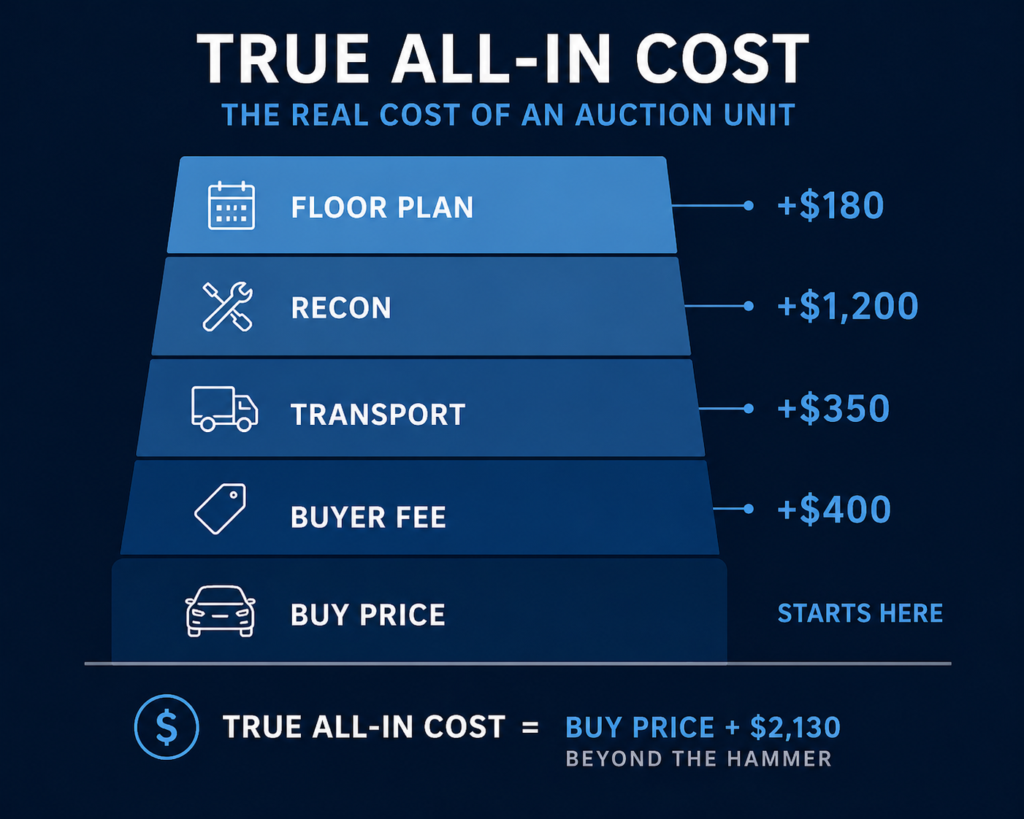
The Complete Auction Cost Stack
1. The Buy Price This is the number everyone tracks. It’s also the only number that shows up cleanly in the deal jacket. Everything below this line tends to get fuzzy.
2. Buyer’s Fee: $300–$550 Every auction charges a buyer’s fee on top of the hammer price. Manheim, ADESA, and the regional independents all have their own fee schedules, and they scale with vehicle price. On a $12,000 unit, you’re looking at $400–$500 before the car has moved an inch. This is non-negotiable, every transaction, every time.
3. Transport: $150–$600+ Regional auction close to your store? You’re on the low end. But regional auctions are increasingly picked clean — dealers are driving further, bidding remotely, and sourcing from out-of-market lanes more than ever. A unit coming from two states over at $500–$600 in transport is not unusual. And that cost hits before you know whether the recon surprises are going to make the unit work.
4. Recon: $800–$2,000+ (and this is the dangerous one) This is where auction math gets genuinely risky. The average recon cost on a trade-in from a known customer — a vehicle whose service history you have, whose ownership you know — is significantly lower and more predictable than an auction blind buy.
Auction units come with condition reports, but condition reports miss things. A paint issue that wasn’t flagged. A mechanical problem that didn’t surface in the lane. Tires that looked marginal in the report and are actually shot. Each of those discoveries happens after you’ve already committed to the unit, and each one compresses your gross.
The average auction unit recon runs $800–$1,500 in a normal scenario. On a problem unit — and you’ll have them — you’re at $1,500–$2,000+ before you’ve put the car on the lot.
5. Floor Plan Carry: Variable, and often ignored The national average days-to-retail on auction-sourced inventory runs longer than on trade-ins. A unit that sits 45–60 days before retailing is accumulating floor plan interest the entire time. At typical floor plan rates, a $15,000 unit sitting 45 days costs you $150–$225 in carry before it sells. Multiply that across your auction volume for the month and it’s a real number — one that never shows up in the deal gross but absolutely comes out of your profitability.
6. Internal Handling: Often untracked Someone has to receive the unit, run it through initial inspection, coordinate recon, photograph it, and stage it for retail. That labor cost exists whether you account for it or not. Dealers with tight used operations track it. Most don’t.
What the Stack Actually Adds Up To
Let’s run a real scenario. A $14,000 unit at auction:
| Cost Item | Amount |
|---|---|
| Buy price | $14,000 |
| Buyer’s fee | $450 |
| Transport | $350 |
| Recon (average) | $1,100 |
| Floor plan (45 days) | $175 |
| True all-in cost | $16,075 |
Now assume that unit retails at $17,500 — a reasonable figure for a $14,000 buy. Your deal jacket shows $3,500 in front-end gross. Your actual gross, accounting for the full cost stack, is closer to $1,425.
That’s not a disaster. But it’s also not $3,500. And on a bad recon — one that ran $1,800 instead of $1,100 — you’re at $725 in real gross on a unit you spent real capital and real time to acquire.
Now multiply that across 20, 30, 40 auction units a month. The aggregate cost of that undercount is significant.
The Comparison Point: What a Database Trade-In Costs
The same cost model applied to a trade-in sourced from a proactive outreach to a past buyer in your database looks materially different.
Acquisition cost: No buy fee. No transport. No auction registration. Your cost to acquire is the cost of the outreach — which, at scale, is a fraction of what you’re paying per unit at auction.
Recon: You know the vehicle. You have the service history. You can estimate recon before you commit to the trade value. There are still surprises, but the range is narrower and the risk is lower.
Floor plan carry: Trade-ins from engaged customers who are actively shopping a replacement tend to retail faster than auction units. A customer who came in to trade is motivated to buy. Faster retail cycle means lower carry cost.
The net: Average all-in cost per unit acquired from your own database is substantially lower than auction — and average front-end gross is substantially higher. As covered in Auction vs. Trade-In: The $3,500 Gross Difference, the spread between the two channels runs approximately $3,500 per unit in gross profit terms.
That number now has more context. It’s not just a gross difference — it’s a cost difference and a gross difference compounding in the same direction.
What to Do With This
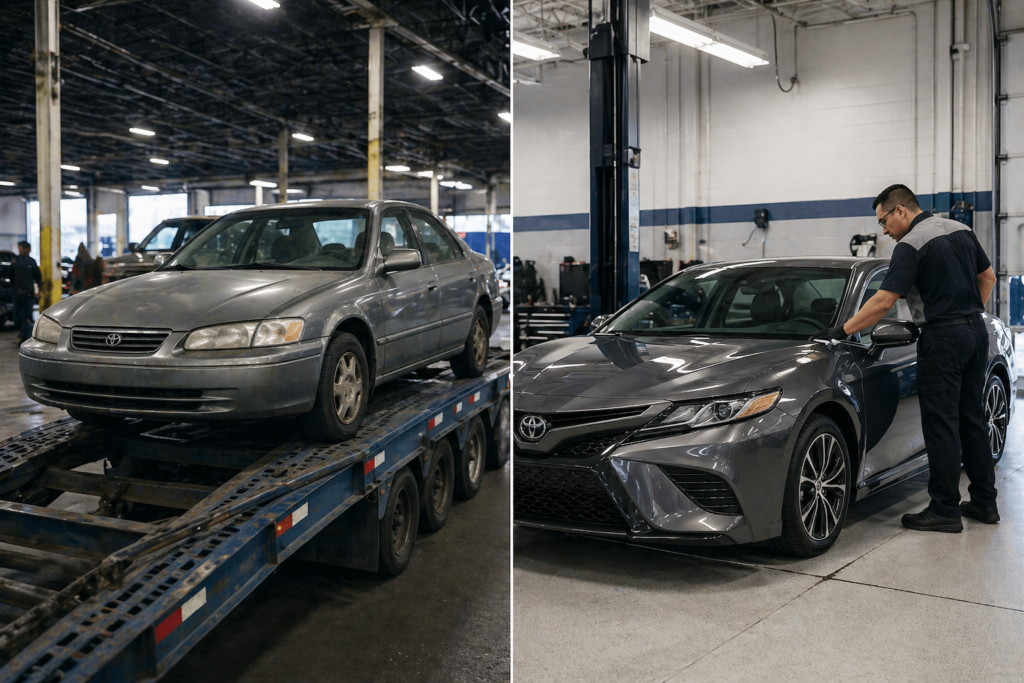
You don’t need to abandon auction sourcing. For hard-to-find vehicles, specific inventory gaps, and markets where your database doesn’t have coverage, it’s still the right tool.
What you need is an honest accounting of what auction units actually cost — not just the buy price and the sell price, but the full stack. Once you have that number, the comparison to database-sourced trade-ins becomes clear on its own.
The dealers who are consistently outperforming their markets on used gross aren’t necessarily buying better at auction. They’re buying less at auction — because they’ve built a reliable, proactive sourcing channel from their existing customer base that produces better units at lower cost and higher margin.
If you haven’t built that system yet, the first question worth asking is: how many upgrade-eligible customers are sitting in your database right now?
Find out what your database could produce →
FAQ
What fees do dealers pay when buying cars at auction? Franchise dealers pay a buyer’s fee on every auction purchase, typically $300–$550 depending on the auction house and vehicle price. This is in addition to the hammer price, transport costs, recon, and floor plan carry — none of which appear in the basic buy/sell gross calculation most dealers track.
How much does recon cost on an auction unit? Average recon on an auction unit runs $800–$1,500 for a clean scenario, but can reach $2,000 or more when condition report surprises surface after purchase. Unlike trade-ins from known customers, auction units carry unknown mechanical and cosmetic risk that makes recon costs harder to predict and budget.
How does floor plan cost affect auction unit profitability? Every day an auction unit sits before retailing accrues floor plan interest. At typical floor plan rates, a $15,000 unit sitting 45 days costs $150–$225 in carry before the sale. Because auction-sourced inventory tends to have longer days-to-retail than trade-ins from engaged customers, this cost compounds across your monthly volume.
What is the true all-in cost of an auction unit versus the buy price? On a $14,000 auction unit, the true all-in cost including buyer’s fee, transport, average recon, and floor plan carry typically runs $1,800–$2,500 above the buy price — bringing total cost to $15,800–$16,500 before the unit retails. Most deal jacket gross figures don’t capture this full cost.
Are auction costs tax deductible for dealerships? Buyer’s fees, transport, and recon costs are generally deductible as cost of goods sold for dealerships. Consult your dealership CPA or controller for how these should be classified in your specific accounting structure — this post covers operational economics, not tax treatment.
Related reading: